
Weszczak Bolesław
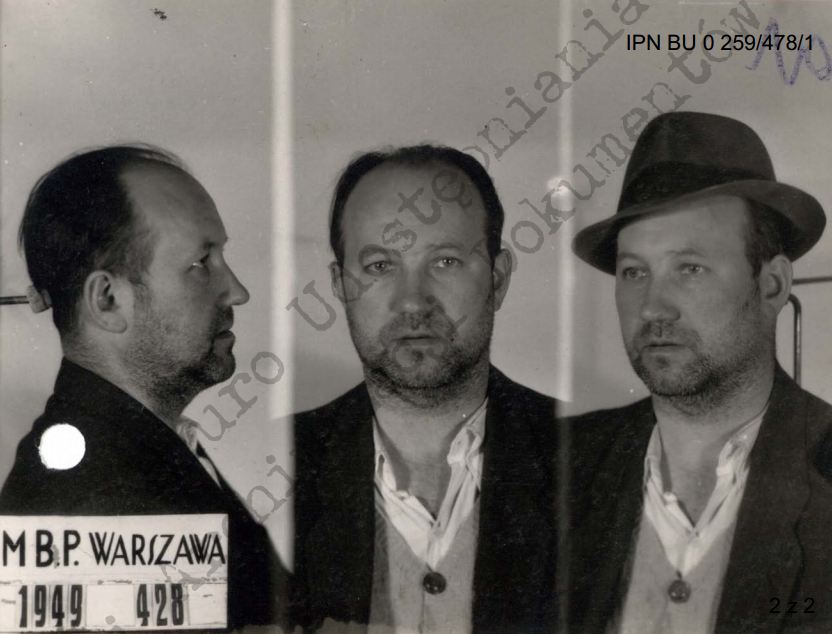
Weszczak Bolesław born on March 23, 1910, in Łódź, son of Józef and Józefa née Szymczak.
He completed 3 grades of primary school. He worked in Łódź as a laborer – a wallpaper painter, he also painted signs and banners, and tried his hand at amateur artistic creation.
Before the war, he had communist sympathies, in 1927 he joined the KZM and from 1930 he was a member of the KPP. He was suspended from membership after hitting another KPP member, who at that time had illegal prints fall out, which threatened deconspiracy. The incident (with no further consequences) had a personal background, although during the post-war investigation, the officers suspected a provocation, but they did not present any other evidence than the one above, therefore (in view of the existence of also a witness statement about the personal character of the incident) the version about the provocation should be rejected.
In March 1932, he was called up for military service and assigned to the 10th Artillery Regiment in Łódź. During his service, he received communist literature from the KPP, and in 1933, he was arrested for three months as a suspect in hanging a red flag at the (neighboring) 28th Uhlan Regiment – he had helped in its preparation. After his release from prison, he was discharged from the military. He continued his activity in the KPP while working as a painter. In 1933, he joined the League of the Godless.
Mobilized in late July 1939 for the 10th Artillery Regiment. Sent to the front near Wieluń and Sieradz with his unit. On September 4, he was wounded and evacuated to a hospital in Łódź, where he stayed until the end of November 1939.
On May 22, 1940, he was arrested by the Germans and, after a short stay in the Radogoszcz camp (now a district of Łódź), sent to the Dachau camp, where he worked as a prisoner as part of the "Mallerkomando" (painting team). There, in 1941 (possibly somewhat later), he met Bogusław Stępiński and joined the group of Zadruga sympathizers led by him, recruited among the camp prisoners. He cooperated with Stępiński until his transfer from Dachau in 1944. In 1943, he was subjected to pseudo-medical experiments conducted by Dr. K. Schilling.
In the camp, he came into contact with German communists and his observation of their behavior (he confided to a fellow prisoner in UB detention that they were no different from the Nazis) may have contributed to his abandonment of internationalism and leaning towards nationalist views.
29 April 1945, liberated by American forces. Returned to the country in August 1945, initially with a transport of Soviet citizens through Linz, Melk, Vienna, and Wiener Neustadt, then on his own with a group of Poles through Budapest and Czechoslovakia to Krakow. During the journey, he was robbed by Soviet soldiers, and it is possible that observing the behavior of "Soviet people" deepened his distance from internationalism. After returning to Łódź, he spent several months recovering and was supported by his wife (a tram conductor in Łódź), and then took up work as a painter. In 1949, he was employed as a distributor of PZPR publications.
In January 1946, he joined the PPR, likely motivated by opportunistic reasons. In spring 1947, Bogusław Stępiński found him and invited him to a meeting of sympathizers of Zadruga in Łódź. Weszczak attended 2 meetings but did not maintain further contact with that environment. His wartime experiences likely contributed to his acceptance of Catholicism – this was his declared faith during interrogation.
Summer 1947, he proposed to his son-in-law Henryk Wira to join active independence activities, and he agreed. Together, they began an activity involving painting anti-communist slogans. The first slogans were painted with oil paint in the summer of 1947 in Łódź. In addition to painting slogans, they also made handmade leaflets, which they pasted on the streets of Łódź. Initially, they did not adopt any name, but later they signed their leaflets with the word “Leśni”. The content of the slogans and leaflets (sometimes written with errors) indicates a combination of patriotic and social themes. These included slogans such as: "Down with Communism", "Down with Bierut", "Down with the PPR", "Down with the Killers of Katyn", "Down with the Jews", "Stalin, you were involved in Katyn" (sic!), "Death to Russia's lackeys and communists," as well as: "Long live Mikołajczyk," "General Anders, save us from hunger and misery," and: "Long live Tito, the Supreme Commander of Yugoslavia." The group also stored 3 pieces of firearms (pistols), but this weapon was not used.
In April 1949, he managed to recruit his acquaintance, a Milicja Obywatelska (MO) officer named Bolesław Koch, and his wife Janina.
Working as a distributor of party press, Weszczak regularly picked up the assigned press in the district committee's office in the morning, where he noticed an unused duplicating machine. On June 28, 1949, he took the duplicating machine and gave it to Bolesław Koch, who stored it in his apartment. Several hundred leaflets were printed on this duplicating machine. Some of the leaflets were managed to be distributed, the rest were lost during the arrest.
The arrest of B. W. took place on 6 August 1949 as a result of a denunciation by an acquaintance, Saturnin Staniszewski (pre-war surname Marchwiecki, in one document the informant is mentioned as Stanisław Stankiewicz), whom he had proposed to join his group. During the investigation, his contacts with B. Stępiński and „Zadruga” were established. The interest in Weszczak in this context is evidenced not only by the questions of the investigators but also by the transfer of his case to Warsaw. His alleged connections with b. are also suspected. Before 1939, the Second Department of the General Staff was allegedly involved in countering communist sabotage, but this has not been proven.
By judgment of the Military Court in Warsaw on January 19, 1950, he was sentenced to 15 years in prison, 5 years of loss of civil rights, and confiscation of property. Together with him, Koch Bolesław and Wira Henryk were sentenced to 10 years each, additionally 5 years of loss of civil rights and confiscation of property. The 1952 amnesty reduced Bolesław Weszczak's sentence to 10 years and the others' to 6 years and 8 months in prison. In a separate trial, the Military Court in Łódź sentenced Stanisław Wira (7 years - he kept his son's weapon, Henryk) and Janina Koch (5 years).
He served his sentence in Warsaw (Mokotów), Wronki, and Nowogard. He was conditionally released on July 14, 1955. He returned to Łódź, where he treated his health problems resulting from his time in the camp and prisons. He was monitored by the Milicja Obywatelska (MO). In 1957, due to his inability to work, he received an invalidity pension.
He died on August 13, 1977, in Łódź. He was buried in the Łódź cemetery in Zarzew.
Although he was only briefly a participant in the Zadruga circle, his case is significant in its history. It became, in fact, a direct incentive for the UB to arrest Stępiński (August 24, 1949), after which the arrest of Jan Stachniuk and Janina Kłopocka followed (September 4, 1949).
Bolesław Weszczak with his wife Helena had daughters Henryka and Grażyna and a son: Bolesław.
Tomasz Szczepański
Sources:
Archives
IPN 00231/153 t 1. Information about "Zadruga", April 21, 1950,
IPN BU 0259/478 t1, 2 Weszczak Bolesław and others,
IPN Ld 030/159 The illegal organization under the name of "Forest Brothers",
Literature
Chańko J. Onufrzak Z. From the history of youth conspiracy in Łódź 1948-1953, Łódź 2005
Grott B. Religion, civilization, development. Around the ideas of Jan Stachniuk, Kraków 2003
Onufrzak Z. Bolesław Weszczak (1910–1977), in: Conspiracy and Social Resistance in Poland 1944-1956. Biographical Dictionary Vol. 1, Krakow-Warsaw - Wroclaw 2002;
Information from Roksana Weszczak, Sławomira Wierzbicka (maiden name: Wira).