
The Individual, the Community, and the Race: Three reference points of Western neopaganism
Dr. Arkadiusz Sołtysiak
Department of Historical Anthropology
Institute of Archaeology UW
Introduction
Neopaganism refers to any contemporary religious movements that draw on pre-Christian European religions in their ideology. This definition is difficult to narrow down because, firstly, neopagans use many often contradictory ways of utilizing pre-Christian (i.e., pagan) motifs, and, secondly, some choose the tradition closest to them (most often Scandinavian, Anglo-Saxon, British, Celtic, Roman, Greek, Baltic, Slavic, though sometimes even Mesopotamian or Indian), while others freely combine different traditions. Leaving aside various marginal groups, in Western neopaganism (mainly Anglo-Saxon, German, and Scandinavian), three main trends can be distinguished: the syncretic one, most often referring to Celtic tradition, which includes Wicca and druidism; the one based on a more or less strict reading of Germanic medieval sources (Asatru and theodism); and finally, the most difficult to grasp, the neo-Nazi trend, in which selectively treated pagan motifs are used to strengthen a completely modern ideology. These three main trends form a spectrum of possibilities, in which the boundaries between individual entities are somewhat blurred, although it must be admitted that the division presented here is well recognized by neopagans themselves, and groups lying on the border between Wicca and Asatru (such as Hrafnar) or between Asatru and Nazi neopaganism (the Order of Jarl Baldar) define themselves as intermediate.
The degree of influence of individual Western neopagan currents is quite diverse. Wicca is the most recognizable, firstly due to the largest number of active participants and sympathizers (estimated in the US and Great Britain combined at several hundred thousand), and secondly because of its connections with feminism and effective publicity efforts such as public rituals at Stonehenge. Asatru and theodism, with their numbers in the tens of thousands, remain in the shadow of Wicca and, outside a few spectacular actions (such as the Kennewick Man case2), struggle to break into public opinion. The least numerous (hundreds of people) and least recognizable are neopagans-Nazis, who, unlike the two previous strongly atomized trends, are strongly centered around leaders, David Myatt and Varg Vikernes.
These three Western neopagan currents differ diametrically from each other in terms of ideology, organization, and worldview. Wicca and Druidism are liberal, more left-leaning, and to a large extent draw on the broadly defined New Age movement. In the ideology of most groups and organizations, there is a strong connection to feminism, manifesting in, among other things, the widespread propagation of the Great Goddess myth, as well as involvement in actions for nature protection, resulting from acceptance of the Gaia concept. The organization is loose, most wiccans practice in small groups or alone, and existing federations focus more on coordinating activities than standardizing doctrine.
On the other hand, Asatru is a more conservative, traditionalist current, focused on building and maintaining family and local ties. The ideal for followers of this form of neopaganism is the world of the Vikings, where people form a community with the gods, and the most important human trait is personal honor. Asatru groups are also small, although they are affiliated with actively operating federations such as liberal The Troth or moderately racist Asatru Alliance in the USA3. Unlike Wicca, magic plays a marginal role in Asatru, while the greatest emphasis is placed on organizing ritual feasts during which community members establish a bond with the gods4, as well as on shaping one's character according to the models transmitted by medieval Scandinavian sagas.
The final type of neopaganism, which is primarily developing in Anglophone and Scandinavian countries, is an extreme racist form of Asatru, closely linked to neo-Nazism. In this current, pagan motifs are often used selectively, mainly to contrast the original Aryan freedom with the slavery that would have been imposed on European tribes along with the Judeo-Christian tradition. The most influential neo-Nazi ideologist who uses neopagan motifs is David Myatt.
Generally speaking, Western neopaganism exhibits a full spectrum of ideological attitudes, ranging from left-wing liberalism to extremist racist nationalism. It is easy to guess that pre-Christian motifs used to justify such attitudes are employed by neopagans in a free and often highly distorted manner. It is also common for entirely modern concepts to be mistakenly identified as elements of historical paganism, such as the Great Goddess myth or Margaret Murray's idea that women burned as witches at the dawn of the modern era were priestesses of an ancient nature cult. The most rigorous approach to ancient and early medieval sources is taken by Asatru neopagans, among whom there are many Germanists and historians; in other currents, source criticism is not applied at all.
A very important element of the ideology of each of the types of neopaganism mentioned here is the vision of society and the resulting obligations of the individual towards their surroundings. Of course, in individual currents these visions are diametrically different, and therefore the way of defining, promoting, and fulfilling deontological guidelines also differs fundamentally. Below will be presented the most important elements defining the individual and society in three Western neopagan currents, with particular emphasis on the differences between the moderately nationalist Asatru and the Nazi ideology of David Myatt. The views of another pagan neo-Nazi, Varg Vikernes, will be treated marginally, as they have already been described elsewhere6.
Wicca: Individuals in the face of the universe
Wicca is essentially a system of magic practice invented in the 1950s by Gerald Gardner, a British eccentric who, inspired by Margaret Murray's books, claimed to be a continuation of a pre-Christian religion that had been secretly passed down from generation to generation during the dominance of Christianity. In the 1970s, Wicca was infused with feminist themes and, as a countercultural cult of the Great Goddess, gained great popularity, especially in the United States and the United Kingdom. A significantly older, though increasingly merging with Wicca in recent years, neopagan trend is Druidism, which is more a result of romantic interest in megaliths and Arthurian legends than an attempt to reconstruct Celtic religion.
Wiccans, both witches and wizards, are primarily interested in various types of magic they practice individually or in small groups. Their worldview, analogous to that of New Age adherents, is built from a variety of ideas provided by contemporary mass culture; hence, Wicca ideology is highly syncretic. It is interesting, however, that despite the freedom in choosing inspirations, the views of representatives of this branch of neopaganism are to a large extent homogeneous and are based on the assumption that there is a magical balance in nature, represented by the pantheistic Great Goddess and her consort the Horned God (identified with various female and male deities from mythologies around the world). According to Wiccans, magical practices should serve to affirm and maintain this balance.
Wiccans are characterized by a strong individualism and a lack of well-defined ethical commandments. Their most important principle (called Rede) is "An it harm none, do what ye will," meaning "If it hurts no one, do as you will" - clearly referencing Aleister Crowley's famous "Do what thou wilt shall be the whole of the Law." Some reverse the order and propose the version “Do what thou wilt shall be the whole of the Law”, which they argue emphasizes more strongly that any action directed against anyone is forbidden, even if it is intended as self-defense7. Nevertheless, Wiccans acknowledge that the Rede is often difficult to apply in practice and one should strive to cause the least harm possible8.
The second important element of Wiccan ideology is the Law of Threefold Return (Treefold Law of Return), which states that any kind of positive or negative energy sent out will return threefold. Therefore, in both magical practice and everyday life, one should strive to act positively rather than negatively9. Some Wiccans reject the Law of Triple Return, arguing that every person's behavior stems from the fact that both oneself and the entire world are part of the same divinity - becoming aware of this is enough to act ethically in relations with other people and towards nature as a whole.
A large majority of Wiccans accept a pantheistic view of the world and believe that maintaining balance in nature is their religious duty. In 1974, a group called the Council of American Witches placed a declaration on the second point of their 13-point code of principles: “We affirm that our reason imposes a unique responsibility upon us for our environment. We wish to live in harmony with Nature, in ecological balance (...)”11.
Isaac Bonewits, the Arcydruid of the A'r nDrai'ocht Fe'in group, expanded on this idea as follows: "We believe that we must respect and love Nature as divinity (...) and recognize ourselves as part of it, not 'masters'. Many of us accept what is known as the 'Gaia Hypothesis', that the biosphere of our planet is a living being deserving of all love and support from us, Her children. We believe that ecological awareness and activism are a sacred duty” and further: “We believe that ethics and morality must be based on joy, love, self-belief, mutual respect, and avoiding harm to oneself and others, as well as increasing public good”12.
Some Wiccans consider themselves panentheists and believe that every human being is absolutely connected to the divine: "If our actions are worthy and ethical, we strengthen the Deity, and if they are unworthy and unethical, the Deity is accordingly weakened"13. In practice, as seen, there is no difference between the declared pantheism and panentheism.
Both the Rede, the Law of Triple Return, and the less formalized guidelines of Wiccan ideologists clearly show that for adherents of this branch of neopaganism, the world is a divine unity whose balance must be maintained by all its constituent elements. There is no mention of any intermediate structures between man and the world; for wiccans (at least according to official declarations) neither family, nor nation, nor society is important: everything takes place only between the individual and the universe. Such a view of the world is extremely individualistic and liberal. According to the Wiccans themselves, adopting it and putting it into practice will allow them to avoid the problems associated with modern civilization, leading humanity to live in harmony with nature and peace. In summary, the Wiccan worldview can be said to be a contemporary variant of Rousseau's utopia.
Asatru: A group in relation to the gods
Neopagans from Asatru14 view the world completely differently. For them (at least declaratively), what is most important is not the individual, but the community: both family as a community of blood, and community of friends united by a common goal, and finally the community of a specific group of people with specific gods. This way of thinking is deeply rooted in medieval sagas describing the predatory expeditions of Viking crews, the democratic society of free peasant-warriors inhabiting Iceland, and finally the long chains of blood feuds.
The fascination with the world and religion of the Vikings began in the 19th century, while the first organizations aiming to recreate Scandinavian (and more broadly Germanic) neopaganism were founded in 1972/3 almost simultaneously in Iceland (Ásatrúarfélagid), the United States (Asatru Free Assembly), and the United Kingdom (The Committee for the Restoration of the Odinic Rite). All three had more or less nationalist overtones, but over time a division emerged within Asatru into a nationalist strand, which upholds the superiority of Germanic culture over other cultures and excludes the possibility of anyone other than a born Germanic person joining the worship of Scandinavian gods, and a liberal strand, in which anyone who feels called by the gods can join the group. Sometimes they are referred to as folkish and universalist respectively15. The conflict between these two streams led to a split in the Asatru Free Assembly in 1987, the first Asatru federation in the United States.
Regardless of one's view on who is worthy of forming a community with the Scandinavian gods, almost all adherents of Asatru place particular emphasis on thorough study of medieval sources describing pagan religion and strive to recreate the pre-Christian worldview as faithfully as possible, which, of course, does not prevent them from supplementing it with entirely modern elements where the sources are too sparse or ambiguous. A modern idea that has gained widespread recognition and become the basis for discussions on ethics in Asatru is the list of the Nine Noble Virtues, which organizes and defines the desirable traits of a pagan. It was published as early as 1974 by John Yeowell, the leader of the British Committee for the Restoration of the Odinic Rite (since 1980 simply known as the Odinic Rite)16. The standard version of the List of Nine Virtues includes the following traits: 1) courage/boldness, 2) truth/sooth, 3) honor, 4) loyalty/troth, 5) discipline, 6) hospitality/guest-friendliness, 7) industriousness/busyship, 8) self-reliance/freedom, and finally 9) perseverance/steadfastness.17 All these virtues are associated with the Viking ethos, and Asatru neopagans find numerous confirmations of them in Icelandic family sagas and a description in Havamal, a poem from the Elder Edda containing a deontological exposition attributed to Odin18.
Along with the list of Nine Virtues, the Odinic Rite also developed a list of Nine Obligations19, which serve as a complement and explanation to the Virtues: 1) To keep loyalty and love to close friends; 2) Never to take a false oath; 3) Not to be harsh with the humble and meek; 4) To honor the elders; 5) Not to let evil go unpunished; to fight against the enemies of Faith, Folk, and Family; 6) To help friends but not to trust the promises of strangers; 7) Not to argue with the foolish words of a drunkard; 8) To give proper attention to the dead: those who died on straw, at sea, or by the sword; 9) To keep the decisions of rightful authority and to accept with courage the decrees of the Norns20. The German branch of Odinic Rite accepted the idea of the Nine Obligations, but completely changed the list: 1) Support Odinism; 2) Practice Odinism; 3) Do not represent Odinism in an unworthy manner externally; 4) Support and protect your family and relatives; 5) Teach Odinism to your children, but leave them free choice; 6) Accept with dignity the differences with other members; 7) Anyone who is bound by mutual solidarity can count on your help in need; 8) Do not avoid conflicts, but engage in them with dignity and moderation; 9) Be prepared to offer reconciliation if you can do it sincerely and worthily.21
Neopagans who refer to Anglo-Saxon tradition (theodists) use their own list of desirable traits, which they call Atheling Thews (Noble Customs). It includes seven qualities analogous to the Nine Virtues (excluding truth and honor) as well as 8) generosity (givefullness/generosity), 9) vengeance (wrake/vengeance), 10) equality (evenhead), 11) friendship (friendship), and finally 12) wisdom (wisdom)22. Garman Cyning of the Theodish Belief group has grouped these traits and concluded that they can be reduced to three primary ones (The Three Wynns), forming an alliterative link with the name of Odin/Wotan: Wisdom (adherence to the ancient wisdom of pagan religion), Worthmind (maintaining a personal sense of honor), and finally Wealthdeal (generosity towards relatives and friends)23.
The List of Nine Noble Virtues is nearly universally accepted, while other lists of traits may vary; sometimes they are accepted only by one faction or even a single group of Asatru adherents. Deontology seems to be one of the most discussed elements of Asatru ideology. Neopagans primarily consider how the Viking ethos can be adapted to modern conditions. The Nine Virtues and other lists are often derived from concepts appearing in sagas, especially troth, frith, and ár, which are widely recognized as foundations of the Scandinavian view of interpersonal relationships.
The term troth is usually translated as "faith," but it refers more to mutual trust between people and gods, a kind of bond based on respect, rather than faith in the Christian sense24. On the other hand, frith means a state of balance in society, when emerging conflicts are resolved using legal mechanisms similar to those applied in the medieval free settlers' society in Iceland25. The last concept, ár, is nothing more than personal honor, respect for oneself and others, and good reputation. In the greatest of shortcuts, one could state that Asatru neopagans strive to build troth under conditions of frith, using ár. The lists of desirable traits presented above are intended to facilitate this process by providing a systematic collection of principles of conduct26, which are eagerly commented on and elaborated upon27. To this end, even a version of the Nine Virtues with a commentary for children has been published28.
For neopagans of Asatru, an ideal society is composed of small, independent family units or groups of friends that are open to the world but also guard their identity closely. All the lists of traits presented above define the ideal member of such a community, who develops his or her personal qualities in order to better fulfill obligations towards family and friends. While in Wiccan ideology family ties and friendship are treated marginally, with the most attention focused on defining an individual's duties towards a somewhat abstractly conceived universe, in Asatru the individual is strongly rooted in their immediate social environment. This attitude is also clearly visible in the organization of Asatru itself, where hundreds of independent groups called Kindreds or Hearths operate, formally only affiliated with national or regional federations. Each such group defines its own character and finds its own way of practicing worship. Similarly, as pagan Scandinavians were primarily members of their clans and their own will was often limited by obligations to relatives and friends, so contemporary neopagans of Asatru strive to promote a communal model of life and find patterns of behavior that define the duties of an individual towards their closest ones.
Although conservative Asatru ideology also includes nationalist elements and an attempt to define the ethnic community as a Family of Families, practical efforts to realize this vision are rarely undertaken beyond general declarations. Only in the Asatru Alliance is considerable attention given to the final battle of Ragnarök, which, according to Valgard Murray, the leader of this organization, will end with the defeat of Judaic-Christianity and the rebuilding of the world by pagan descendants of the peoples of northern Europe29. However, Murray's views are already more akin to the neo-Nazi concept of the struggle of the Aryan race with other races than to the communal worldview that forms the basis of the Asatru ideology.
Neopagan Nazism: Race in Peril
Neopagan motifs are sometimes used by contemporary neo-Nazi ideologists, among whom the most original is probably David Myatt, born in 1950, author of the influential book “The Numinous Way of Folk Culture”, founder of the National Socialist Movement and Reichsfolk, ideologist of the terrorist organization Combat 1830, and since 1998 a Muslim and propagator of terrorist attacks against Western civilization.
Myatt declares that he is a supporter of racial diversity. In his opinion, each race has its own culture, heritage, and destiny, which it should be proud of; the destiny of the Aryan race, to which Myatt himself belongs, is to uphold and develop civilization. The Western civilization, in which only the pursuit of profit matters and differences between people are erased, and the heritage of individual races fades away, is a threat to all races32. Therefore, one must fight in all possible ways against Western civilization and try to create a new system in which people (that is, Aryans) will abandon capitalist thinking and begin building a Galactic Empire based on national-socialist principles.
The Western civilization is not the only enemy of David Myatt. The second enemy (which is, however, related to the first) is the Judeo-Christian culture, which is opposed to paganism as a way of life in harmony with nature. In Myatt's opinion, Christianity and other religions focus on the individual, while Aryan paganism prioritizes the racial community. Sometimes an individual must sacrifice themselves for the good of their culture or cosmos35, and it is this ability to sacrifice oneself and reject personal happiness in favor of fulfilling duties towards nature that Myatt calls honor. The goal of every person should be to support the evolution of Nature by striving for personal perfection and the perfection of their own culture36.
In the early period of his activity, Myatt wrote extensively about Aryan racial supremacy, but after converting to Islam, he came to believe that racism was incompatible with national socialism and - unlike most neo-Nazis - stated that the enemy of the Aryans were not other races, but themselves, specifically their "lack of understanding, lack of honor, inability (most often due to laziness) to change for the better through willpower". Aryans can and should interact with other races (especially Muslims) in the fight for a better world, of course, on the condition that each race remains on its own territory and does not interfere with others37.
Sam Myatt, despite his conversion to Islam, considers himself a pagan38, although it is difficult to find explicit references to pre-Christian religions in his writings. The Aryan culture contrasted with modern civilization is an abstract concept, in which the warrior ethos, although very generally characterized, occupies the most important place, but it is difficult to find elements borrowed from Scandinavian sagas or other original sources.
In the 1980s and 1990s, Myatt sought to promote his worldview within occult, satanic, and neopagan circles. He hoped that through appropriate education, he could persuade young people interested in various strains of the "Left Path" to accept and pursue his goals. Among the groups and organizations under Myatt's direct or indirect influence (for which he published under numerous pseudonyms), the most significant were the satanic Order of the Nine Angles, the satanic-neopagan Black Order, and finally the neopagan Fraternity of the Jarls of Balder. This last organization, headquartered in the United Kingdom, founded in 1990 and operating in dozens of countries (including Poland), seeks to achieve Myatt's goals: to prepare as many people as possible for the final battle of Ragnarök, in which pagan tradition will triumph over Judaeo-Christianity. Then, a new Western Aeon will begin and people will, through self-transformation, become a new species called "Homo Europaeus" or "Homo Galactica"40. The Brotherhood conducts very active activities by organizing various events, promoting physical activity and the practice of martial arts (which brings it closer to warrior brotherhoods), and finally selecting candidates for the Loki Brotherhood, an internal group from which Myatt could recruit members for his Nazi organizations.
Although the Brotherhood of Jarl Björn is recognized as a neopagan group, traditional pre-Christian motifs are used there purely instrumentally. The ideologues of the Brotherhood particularly exploit the Scandinavian idea of the final battle between the gods and the threatening giants, but completely change its meaning: in Norse mythology, this battle will end with the destruction of the entire world and all participants will die, while for the followers of Myatt, Ragnarök will end with the triumph of the Aryans, who will lead the world towards a bright future.
In an even more radical way, the world is understood by the Norwegian neonazi and musician, Varg Vikernes41. According to him, the individual is worth nothing "until they act for the race, until they serve the race above all. The most important thing is self-sacrifice, the will to self-sacrifice - for the good of the race". Vikernes, along with his comrades in the Allgermanische Heidnische Front, promotes racial hygiene and aims to establish a state dominated by fair-haired Nordics who, blindly following their leader, will be able to secure the living space necessary for implementing pagan culture. Unlike Myatt, whom he also considers racially impure, Vikernes believes that the Nordic race is superior to other races and naturally predestined for domination. He even goes further and proposes a mystical understanding of the Nordic race as the body of the god Wuotan (Odin) - thus racial hygiene becomes a religious duty.
Both David Myatt and Varg Vikernes use neopagan motifs to a greater or lesser extent, but they are subordinate to the overarching idea of fighting for racial purity and the possibility of developing Aryan (in Myatt's case) or Nordic (in Vikernes' case) culture. For both of these neo-Nazi leaders, the aspirations of the individual mean nothing, nor does the family or the community of friends; the only active subject worth considering in the world is a rather abstract race, which must fight its own weakness or other races, who are secretly striving to destroy it. The ultimate goal of this struggle is to realize a utopia: to generate, in an unspecified way, a new species of human being capable of conquering space or to create a racially pure society.
The reception of Western neopaganism in Poland and Lithuania
To conclude, it is worth asking to what extent the various Western neopagan movements and their ideologies are recognized in Poland and to what degree they can influence the worldview of Polish groups and organizations. To answer this question, data from surveys conducted between 2002-2004 among Polish and Lithuanian neopagans were used. The following groups were examined: Association For Tradition and Culture "Niklot", a nationalist organization drawing on the Zadruga of Jan Stachniuk (N=16), the Native Polish Church of Lech Emfazy Stefanski, a group with a more eclectic character, belonging rather to the broadly defined New Age movement (N=16), Polish warrior and Viking brotherhoods (N=11), and Lithuanian Romuva, a moderately nationalist organization aiming to recreate indigenous pagan tradition based on ethnographic data (N=24).
The survey included a closed question about the degree of familiarity with the views of selected neopagan ideologists, including the founder of Wicca Gerald Gardner, leaders of various Asatru groups (Sveinbjorn Beinteinsson, Stephen McNallen, and Edred Thorsson), as well as David Myatt, and Aleister Crowley as the most famous representative of occultism. Additionally, an open question was asked about the knowledge of various neopagan currents and groups. In the latter case, the most frequently occurring responses regarding Western neopaganism are Asatru, Wicca, and druidism for general trends, as well as the names of three specific organizations: the Fellowship of Jarl Baldar, the Pagan Federation (a federation primarily comprising Wiccan and druid groups), and Wotan's Folk (one of the Asatru groups with a tribal character). The collective summaries of responses are presented in bar charts. Due to the small number of responses, their distribution was not statistically tested.
In almost all cases, the members of the "Niklot" Association surveyed declared the greatest knowledge about Western neopaganism, and only in the case of specific names of important Asatru ideologists did the members of Romuva show greater familiarity. However, in this case, the number of respondents who were even vaguely familiar with a given name was negligible.
The general names of two neopagan currents, especially Asatru, are fairly well recognized by members of the „Niklot” Association and somewhat less so by Lithuanian neopagans. It is characteristic that an organization with a rather radical nature, the Brotherhood of Jarl Björn, is known only by members of the „Niklot” Association and members of the brotherhoods - here, it is probably important that the Brotherhood had a cell in Poland. Moreover, one of the members of Romuva mentioned the All-Germanic Pagan Front, whose ideologist is Varg Vikernes.
When it comes to knowledge of names, Aleister Crowley is the most recognized (especially in Poland). The name Myatt means nothing to members of Romuva, but it is fairly well known among members of the "Niklot" Association and has also been heard by members of the fraternities (which proves Myatt's effectiveness in reaching such circles). Gardner is known to a few representatives of all groups, although "Niklot" stands out here as well.
Generally speaking, it can be stated that members of the „Niklot” Association declare the greatest knowledge about Western neopaganism, especially its more right-wing branches, while the least interest is shown by members of RKP. Lithuanian neopagans also have very little knowledge of Western neopaganism. Only the ideology of David Myatt could potentially serve as an inspiration for nationalist variants of Polish neopaganism, although it seems that in practice, members of the „Niklot” Association and other groups from this current do not draw inspiration from Western sources, but rather from the writings of Jan Stachniuk and other adherents of Zadruga.
Declared knowledge of various Western neopagan currents and organizations among Polish and Lithuanian neopagans
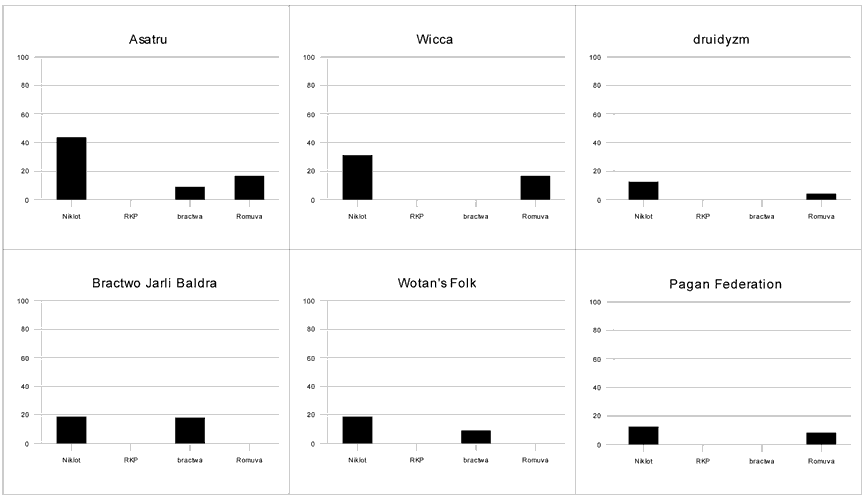
Chart 1. Self-reported knowledge of various Western neopagan currents and organizations among Polish and Lithuanian neopagans (in percentages).
Declared familiarity with the views of various neopagan ideologists and Aleister Crowley among Polish and Lithuanian neopagans
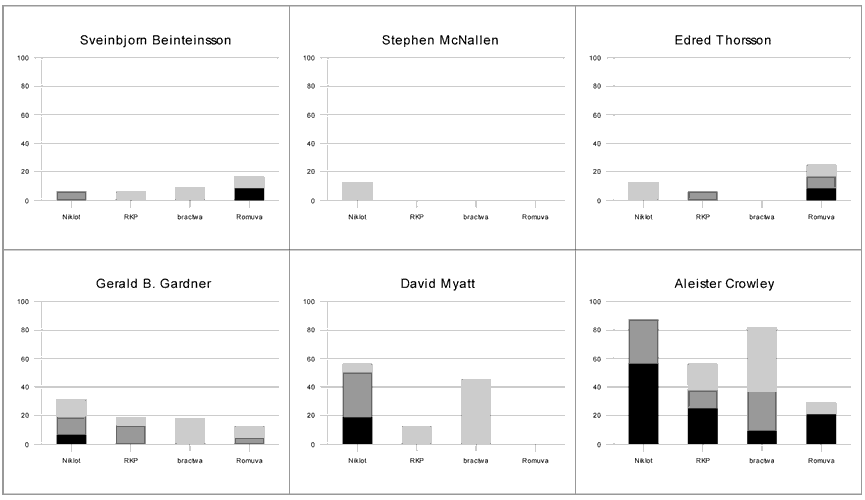
Chart 2. Self-reported knowledge of the views of various neopagan ideologists and Aleister Crowley among Polish and Lithuanian neopagans (in percentages). Different shades of gray indicate various degrees of self-reported familiarity with the views of a given author.