
Nowacki Walenty „Sławomir”
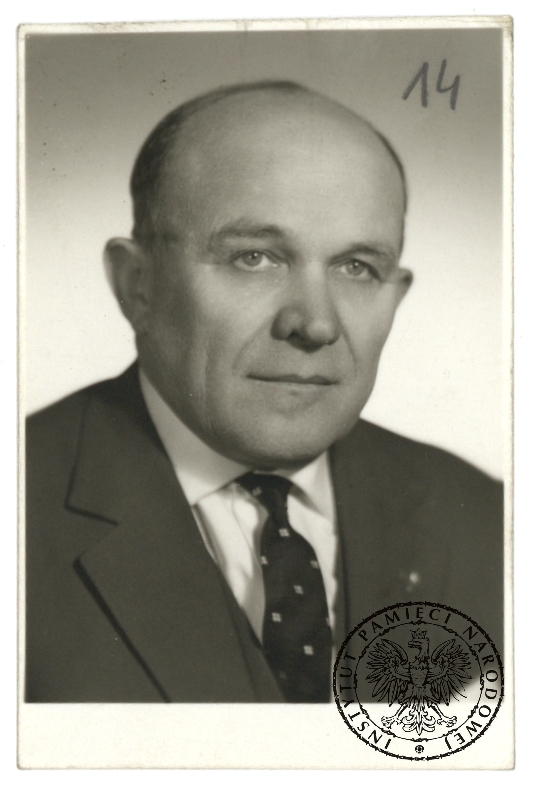
from the IPN collections
Walenty Nowacki „Sławomir” was born on January 26, 1906, in Grzymaczew (Sieradz Land), son of Marcin and Józefa, née Łyczka. He was born into a peasant family and had five brothers.
He fought as a volunteer in the Polish-Soviet War in 1920 (probably exaggerating his actual age).
Together with his brother Jan, he graduated from high school in Kalisz and then studied at the Faculty of Chemistry at the Lviv Polytechnic from 1924 to 1928, obtaining a diploma as a chemical engineer.
He then worked in various state-owned enterprises as a chemical engineer, living in Warsaw since 1937. He was employed, among others, at the Balloon and Parachute Factory in Legionowo, also practicing balloon sports.
After the monthly magazine "Zadruga" was published, he contacted the editorial team, adopting the name Sławomir.
During the occupation, he lived in Warsaw and was involved in trade. His involvement in the resistance is not known.
In 1945, he settled in Bytom where he worked as an industrial advisor for private companies. He also was active in the PSL.
Re-establishes the Marine League in the Upper Silesia region, serving as its president and vice-president.
From May 1947, he resides in Warsaw again, running a private chemical company with his brother, and from 1949 works in various state-owned enterprises.
He was one of the revivers of Polish ballooning after World War II. On February 24, 1957, the Balloon Section of the Aeroklub Warszawski (Warsaw Aero Club) was established through the efforts of Warsaw-based balloonists, and the leadership of the section was entrusted to Nowacki. He led the work on building the first post-war Polish sport balloons, as head of the Balloon Workshop at the District Aviation Plants in Warsaw's Gocław. On May 26, 1957, he made – along with Zdzisław Dudzik – the first post-war Polish free balloon flight (balloon „Syrena”). In 1958, flying the balloon "Poznań," he took first place in the I Krajowe Zawody Balonów Wolnych (First National Free Balloon Competition) in Poznań. On September 7, 1958, he was scheduled to fly the balloon "Poznań" from Gniezno, but due to his leave, he gave up his flight to Franciszek Hynek, who tragically died at that time. He also lectured at the balloon course conducted by the Aeroklub PRL in 1962.
Around 1960, with his second wife (Halina Krystyna Kozera-Nowacka, née Pindor), he founded a craft workshop in Warsaw at Zelwerowicza Street producing items from plastic materials.
In 1964, he left for Belgium, declaring a tourist trip and to visit family. He left the PRL permanently with his wife. Initially, he settled in West Germany, where he worked in his profession, and in 1966, he settled permanently in the USA. Former balloon sportsmen helped him establish professional contacts. In the USA, he worked, among other things, as a patent expert. He also cooperated with Chemical Abstracts.
He achieved professional and consequently material success there, but was disappointed when he observed the level of public education (and consequently the cultural level of the masses) as well as
moral level. He was also troubled by the possibility of a racial war between blacks and whites.
He expressed his thoughts in 2 books and letters to politicians in the USA. He advocated for a return to isolationist policy and basing defense primarily on nuclear deterrent potential, as well as introducing referendums in the US Constitution. The lack of interest in his work (no reviews, even critical ones) deepened his pessimism, and he believed that the USA would not survive until the end of the 20th century.
In December 1973, he sent an article to "Życie Warszawy" dedicated to description and critique of the American lifestyle. The text was taken over by the SB, which suggested to the PRL intelligence residency in New York to have a conversation with N. regarding possible exploitation or recruitment. During the conversation with the residency officer, N. stated that the future of the world is Chinese communism, and societies cannot exist without a sense of fear of god, hence the USSR made a mistake by condemning Stalin, through which it will lose. He declared the creation of a political party in the USA.
After receiving the memo from this conversation, the PRL intelligence headquarters in 1974 gave up on further contact. due to the age and personality of the subject.
In April 1980, he reestablished contact by mail with Eryk Skowron, who lived in Warsaw, asking him for help in publishing his book in Poland. However, Skowron, who was a TW (informant) for the SB (Secret Police) from 1978 to 1980, forwarded the letter along with translated excerpts to his case officer.
In 1993, he reprinted in New York with his own foreword. Humanity and Culture Stachniuka. In the preface, he outlined his views. To maintain eternal world peace, a Centropa federation should be created consisting of: Germany, Austria, Poland, Hungary, Czech Republic, Slovakia, Romania, Bulgaria, former Yugoslavia, Ukraine, Lithuania, Latvia, Estonia (the absence of Belarus is likely an oversight). It is necessary to establish a united church of all Christians, which will begin within Centropa, and Christian love feelings They will become the moral content of the new man. He agreed to the leading role of the German factor in the economy of such a union, Germany would have to agree (in exchange?) to disarmament. Nuclear weapons should be subordinated to a special command under the UN Secretary-General composed of him and a representative of the USA and Russia. He suggested resettling Negroes from the USA to Africa or subsidizing mixed marriages in order to create a new race, all aimed at preventing a civil war in the USA when the black population exceeded 40 percent.
He also advocated for subsidized resettlement of Muslims from the Balkans to the Caucasus, Christians from the Caucasus to the Balkans, and Palestinians to Arab countries, in order to separate the hating nations, which would ensure peace. He did not explain how these ideas relate to those he preached in his published book, other than that they are intended to intensified cultural and civilizational creativity It also concerned Stachniuk. He suggested there that he had talked to Gomułka before his arrest in 1949, which is doubtful (also because at that time Gomułka was no longer the Secretary-General of the PZPR, which Nowacki incorrectly stated). He also wrote that it was he who successfully intervened in seeking to revise the sentence on "Stoigniew", which cannot be true in terms of the effectiveness of this intervention, even if something like this did take place (which is not confirmed by any other sources).
He still lived in 1996, when he was mentioned. Who's Who In Polish America No data on date and place of death.
Decorated with a medal for participation in the 1920 war.
Married to: Ewa Koszyk-Nowacka, née Kamieńska, daughter Marzena (1943), Halina Krystyna Kozyra, née Pindor. Son Przemysław (with Alina Potocka) born 1942.
Sources:
Archives
IPN BU 1423/2266 Alien's personal file: Nowacki Valentin, born 21.01.1906
IPN BU 01237/686
IPN BU 00277/502 t 2 File: Work File. Secret Collaborator "66" [Eryk Skowron, son of Robert, born 1912] - there the translation of Nowacki's text
Literature
Kozak Z., Moszumański Z., Szczepański J. Lieutenant Colonel Franciszek Hynek 1897-1958, Pruszków 2008
Morgała A. A Walk Among the Clouds, 2010
Tomasiewicz J. Political groups and social organizations in the Silesian-Dąbrowa Voivodeship, in: 1945 in the Silesian-Dąbrowa Voivodeship, edited by A. Topol, Katowice 2004
Wacyk A. Jan Stachniuk 1905-1963. Life and Work, v. 1976, v. 1978, v. III, 1984, ts. sup. xerocopy in the author's collection,
Who's Who In Polish America, 1-st edition 1996-1997, ed. B. Wierzbiański, New York 1996
Works of Walenty Nowacki
Jan Stachniuk and his role in the future development of humanity [Introduction to: Jan Stachniuk] Humanity and Culture, New York 1993]
Opr. T. Szczepański