
Tilgner Damazy Jerzy "Jaromir"
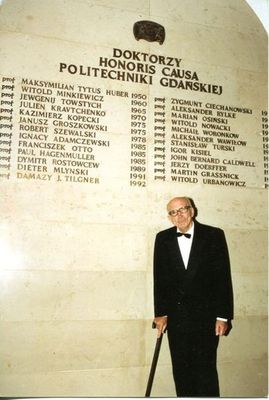 Tilgner Damazy Jerzy, son of Hieronim and Kazimiera née Wolańska, born on November 26, 1904, in Miejska Górka (Greater Poland), was one of five children. His father ran a Polish mail-order business, the Society of St. Ralph, in Berlin, employing only Poles, but after Poland regained independence, the family returned to Poznań. Hieronim Tilgner lost most of his wealth invested in Russian railway stocks, which the Bolsheviks nationalized without compensation, contributing to his early death from a heart attack. Damazy and the rest of his siblings were raised by their mother.
Damazy Tilgner graduated from the Karol Marcinkowski Gymnasium in Poznań in 1923. He then studied agricultural technology from 1923 to 1927 at the Adam Mickiewicz University in Poznań, defending his master's thesis under the supervision of Prof. T. Chrząszcz.
He refused an offer of assistance and went to the USA to familiarize himself with the methods of food preservation there (the country was then a leader in this field of production). He worked, among other places, at the Armour & Co. canning factory in Chicago as a worker (in total, in 6 factories), and in the academic year 1929/1930 at the University of California in Berkeley. After returning to the country, he worked on his doctoral thesis, which he defended in 1932 at UAM, and at the same time wrote a book about the American processing industry. Because no national publishing house was interested in this work, he published it in Germany (The canning industry in the United States of North America, Braunschweig 1932), and a French translation was published in 1933.
The inability to find work in the country made him work at the Canned Food and Jam Factory in Potsdam as head of modernization from 1931-32.
Starting from autumn 1932, he worked at the State Institute of Standardization for Export as the head of standardization. He developed quality requirement standards and also popularized new food preservation technologies, including ham exported to American markets as "polish ham".
Since 1935, he has worked as the chief inspector of standardization in the Union of Industrial and Commercial Chambers.
In 1939, not mobilized due to a leg injury. Worked in Warsaw for 2 years as a trustee in Polish factories taken over by the Germans, and until the end of the war as a consultant at the "Woka" factory producing marmalade and artificial honey.
At the same time, he is involved in the independence conspiracy and with Zadruga. He becomes a member of the circle around the publication "Zryw" (from 1943, Stronnictwo Zrywu Narodowego). He leads the "economic self-defense" action within it, analyzing the composition of foodstuffs sent as ration cards for the Polish population. ("Zryw" and Kadra Polski Niepodległej cooperated here with RGO in agreement with AK). Entrepreneurs who falsified products intended for the Polish population on their own were warned or punished. It was for this activity that he received the AK Cross.
He adopts the pseudonym "Jaromir", which is also his Zadruga name, which he used until the end of his life among friends. He also conducted lectures on economics for the young sympathizers of "Zadruga" known as "kosynierzy". For this activity, he prepared a clandestinely published brochure titled "20 lat pracy od podstaw". He also arranged false covers for the clandestinely published "Zagadnienia totalizmu" by Jan Stachniuk.
In his apartment on Saska Kępa (where he set up 2 concealed hiding places), Jan Stachniuk temporarily hid in 1943. He also stored his documents and money there, as well as those of the cichociemny (Polish secret agent) Adam Borys ("Pług," later commander of the "Parasol" battalion). The apartment itself was also one of the contact points for the Delegatura Rządu na Kraj (Government Delegation for the Underground).
In January or February 1945, he accepted the offer of a representative of the "Lublin government," Mr. B. Rumiński, to work in the Operational Group "Pomerania," where he was the Main Delegate for Economic Affairs in Pomerania, based in Bydgoszcz. The group was a government agency tasked with taking over industrial plants from Soviet military administration and establishing Polish civilian administration there. He employed Jan Stachniuk in this group, who was then using the false name M. Adamek. Tilgner accurately reported on the looting by Soviet troops and the Soviets' fraud in handing over property or its valuation, which required courage in the political reality of the time. The group ceased operations in March 1945.
He rejected the proposal from Minister Minc to work in administration, remaining in Bydgoszcz where he organized the State Institute of Rural Economics, within which he headed the Department of Agricultural and Food Technology. He joined the leadership of the Spółdzielnia Wydawnicza „Zryw” („Zryw” Publishing Cooperative), led by Zygmunt Felczak, becoming its secretary. Under „Zryw”, “Człowieczeństwo i kultura” by Stachniuk was published (Poznań 1946).
In 1947, he obtained his habilitation at the Adam Mickiewicz University in Poznań.
At the same time, he agreed to become a member of the KRN (1945-1947 from the Bydgoszcz constituency) and the Constituent Assembly (1947-1952) from the Opole constituency on behalf of the Stronnictwo Pracy, to which the "Zryw" group had joined. From the Congress of SP in December 1946, he was also a member of the party's management, and from February 1949, he became the secretary of the SP's National Council. In the Constituent Assembly, he was one of the two vice-presidents of the SP club. His speeches mainly addressed economic issues, characterized by the substantiveness of arguments and a high degree of independence. The historian studying them (W. Bujak) noted the similarity of the solutions suggested by Tilgner to those adopted in Japan after 1945.
In the fall of 1949, he left the SP along with a group of former members of "Zryw" around F. Widy-Wirski. He refused to join the PSL or the SD, remaining as an independent and silent deputy, understanding the futility of parliamentary speeches in the prevailing circumstances. After completing his term, he completely withdrew from political life in the PRL, dedicating himself solely to science.
Throughout his life, he remained a supporter of Zadruga. In 1949, Jan Stachniuk hid the manuscripts of his three unpublished works with him: „Chrześcijaństwo a ludzkość” („Christianity and Humanity”), „Drogi rewolucji kulturowej w Polsce” („Paths of Cultural Revolution in Poland”), and „Mit słowiański” („Slavic Myth”). Tilgner kept these manuscripts until 1971, when he passed them on to Antoni Wacyk.
Already in 1947, he began lecturing at the Gdańsk University of Technology while commuting from Bydgoszcz. Since 1950, he has headed the Department of Animal Product Technology at the Gdańsk University of Technology.
In 1952, he became an extraordinary professor, and in 1960, a full professor at the Gdańsk University of Technology. (At that time, he was the first full professor at the Faculty of Chemistry of PG). At this university, he supervised 216 master's and engineering master's degrees and 10 doctorates. Throughout his life, he published around 250 scientific works - books, articles, and contributions.
In 1966, he was elected chairman of the International Committee on Food Science and Technology.
In June 1967, the Security Service intercepted his private letter in which he expressed critical views on the Middle East policy of the PRL, also lowly evaluating the civilizational achievements of Arab countries. The letter also contained sarcastic remarks regarding the PRL's technocratic intelligentsia from social promotion and (low) intellectual level of their spouses.
In November 1967, the Provincial Prosecutor requested the Disciplinary Ombudsman for Scientific Employees of Gdańsk University of Technology to initiate disciplinary proceedings against him. This form of action was likely adopted because bringing a case against him would have been politically and propagandistically awkward due to the formally existing constitutional guarantees of correspondence secrecy. However, the SB (Secret Service) could count on the compliance of most of the academic staff. On January 3, 1968, the Senate of the Technical University of Gdańsk suspended him from his duties (out of 28 voting, only 1 abstained). On January 13, 1968, the Disciplinary Commission for Scientific Employees of the Technical University of Gdańsk, composed of: Prof. Stanisław Szymborski, Prof. Józef Rybicki, and Prof. Józef Wiąckowski, ruled on the dismissal of Prof. Tilgner from service. The decision was upheld by the Higher Disciplinary Commission under the Minister of Education and Higher Education, to which Tilgner appealed (only Henryk Samsonowicz dissented among the five members). This resulted in compulsory retirement. His works were not reissued in the country, and his name was sometimes expunged as a co-author of collective works.
He published abroad and also provided expert opinions for foreign companies on request.
After August 1980, students and colleagues began efforts to rehabilitate the professor.
In 1986, he was rehabilitated by both Disciplinary Commissions (the Gdansk and ministerial ones), but this was not announced publicly.
In 1992, he received the honorary doctorate from Gdańsk University of Technology.
Decorated (in addition to the aforementioned Cross of the Army Krajowa): OOP and "Medal for Warsaw 1939-1945".
He practiced hunting, sailing, and rowing, and was president of the Polish Rowing Societies Association for one term. He was a 5-time Polish champion and 3-time international champion in rowing.
He died on February 19, 1997, in Sopot, where he was buried.
Married to Halina, née Hauffe, children: Małgorzata, Ika.
Sources:
Archival: IPN Gd 321/127;
Articles and Studies:
b. a. (Students and collaborators) Founder of a scientific school, "Gazeta Wyborcza" 1-2 III 1997;
W. Bujak History of the Labour Party 1937-1945-1950, Warsaw 1988 (published by ODiSS)
R. Frączak Professor Damazy Jerzy Tilgner photocopy in the author's collection
B. Grott Religion, civilization, development. Around the ideas of Jan Stachniuk, Kraków 2003
A. Grzybowski I am worth as much as I have created..., "Dziennik Bałtycki" 1986-12-31/ 1987-01-01
J. Jakubowski At the rear of the front, "Pomerania" 4/1989 (April 1989, with also a reprint of several reports by T.)
40 Day of shame, day of glory, "Dziennik Bałtycki" 25 IX 1992;
40 Who was Professor Tilgner, "Dziennik Bałtycki" 28 II 1997
E. Kowalska In Search of Professor Tilgner's Shadow, www.mmtrojmiasto.pl
J. Radzymińska Always Independent Wrocław 1991 (also as "Jaromir")
Z.E. Sikorski Damazy Jerzy Tilgner 26.11.1904-19.02.1997, "Magazyn Przemysłu Rybnego" 2/1997
A. Wacyk Foreword, in: Stachniuk J. Slavic myth Wrocław 2006
Other:
Letters from Margaret Białokoz-Smith (maiden name Tilgner) to the author dated July 26 and August 19, 2011.
Photocopy of 2 pages from the mail order catalog of the Society of St. Ralph;
Dedication by Teodor Jakubowski to D. T. "Jaromił" (incorrect pseudonym), photocopy in the author's collection. Information from Aleksander Kierski.