
Słonczyński Józef "Niklot"
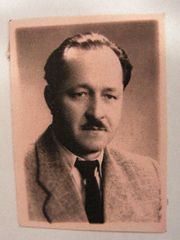 Józef Słonczyński was born on April 17, 1908, in Bochnia, son of Wojciech (a miner at the salt mine in Bochnia) and Anastazja, née Chrobak.
In 1930, he graduated from the Kazimierz the Great Mathematics and Natural Sciences High School in Bochnia.
After passing his matura, he studied at the WSH in Krakow and in 1931-1932 he completed the SPR No. 2 in Biedrusko. After serving in a military unit, he was transferred to the reserve as a sergeant cadet. He returned to his studies, but due to his difficult financial situation, he took up a job at the Tax Office in Bochnia, where he worked from 1932 to 1939.
Mobilized in August 1939 as a second lieutenant to the 16th Infantry Regiment as a battalion paymaster. After his unit was broken up in early September 1939, he joined another (probably) 10th Armored Cavalry Brigade under Colonel S. Maczek, with whom he crossed the Hungarian border on 18 IX. From Hungary (after staying in an internment camp in Visegrad), via Yugoslavia and by sea, he reached France, and after its fall, went to Great Britain where he served in the Polish Army.
From the autumn of 1941 to 1943, he served (with the consent of the command) in the British colonial troops in Nigeria. In 1944, he returned to Great Britain where he continued to serve in the Polish Armed Forces (in 1945, he was promoted to the rank of lieutenant) and treated malaria, which he contracted in Africa. It is likely that during this time he met Antoni Wacyk and became a member of Zadruga.
In 1944, along with Antoni Wacyk, Wilhelm Kwaterniak, Stanisław Opolski, and Tadeusz Then, he edited the publication "Goreją Wici" promoting the ideas of Zadruga. He wrote in this publication under the pseudonym Niklot. He helped publish "Kultura Bezdziejów" by A. Wacyk (Scotland 1945).
In June 1946, he returns to the country with A. Wacyk. Initially, he arrives in Bochnia, where his wife and son lived (also during the occupation). In the fall of that year, he settles in Zabrze, where, along with Wacyk, he establishes an oil mill, and then a foundry model shop (run by Słonczyński). The latter endeavor provided him with a source of livelihood and allowed him to financially support the printing of Stachniuk's works, the latter being the intended purpose of these ventures. In his apartment in Zabrze in 1947-1948, meetings of the Zadruga members took place, including visits from J. Stachniuk, J. Kłopocka, M. Czarnowski, and A. Wacyk. For a short time, part of the print run of J. Stachniuk's "Człowieczeństwo i Kultura" was also stored there.
Due to high taxes, he transferred his business to the state-owned "Biprohut" in 1949, but continued to manage it, gaining some material benefits, which the UB used for blackmail.
In August 1949, he was recruited by the UB in Zabrze as an informant codenamed „Czyński,” using compromising materials („kompromaty”)—that is, the fact that he had been in the Polish Armed Forces in the West and that he ran his own business. The UB files indicate that his activity in „Zadruga” was not known to them, and Słonczyński himself did not mention it. The UB, carrying out the recruitment, hoped that he would provide information about his acquaintances from work with endecian sympathies. To this end, his transfer to work at the State Clinical Hospital in Zabrze was also arranged, where there were supposedly strong endecist sympathies. However, his information did not have operational value and Based on the materials obtained from the informant throughout the entire period, no case was completed nor was any single arrest made. (as assessed by an UB officer in 1954). Słonczyński in 1954 categorically refused to cooperate and does not attend meetings, which caused it to be disconnected from the operational network on 8 July 1954.
In 1951-1973, he was employed at the Municipal Construction Enterprise in Gliwice, last position - Director for Production Means. He remained a non-party member throughout the period in question. Retired since 1974, he lived in Gliwice.
After 1955, he reestablished contacts with the Zadruga circle. He was visited by J. Stachniuk, A. Wacyk with his wife, and also T. Then, when he visited Poland. At least once, the Gods' Holiday was celebrated in his apartment (around 1955).
Married to Wanda, née Podołowska, sons Bogusław (born 1937) and Bogdan (born 1947), and illegitimate son Peter Fletcher (born in the UK in 1941).
Decorated with the SKZ, the Knight's Cross of the OOP, and the Rationaliser of Production badge, as well as British decorations: the Defence Medal, The War Medal 1939-45.
He died in Gliwice on April 21, 1975, and was buried there at the Central Cemetery.
Sources:
Archive:
IPN Ka 00144/1130 – Files of a secret collaborator with the pseudonym “Czyński” (including S’s own-hand life story)
Let from the Ministry of Defence of Great Britain to B. Słonczyński with the course of service from 10 July 2000 (there as Józef Jan Słonczyński)
Press
"Burning Torches", 1944
Studies:
Szczepański T. "Goreją Wici" - an emigrant publication of the Zadruga circle in Great Britain (in print).
Wacyk A. Jan Stachniuk 1905-1963. Life and Work, v. 1976, v. 2 1978, v. III, 1984, ts. sup. xerocopy in the author's collection;
Information by Bogusław Słonczyński.