
Skowron Eryk
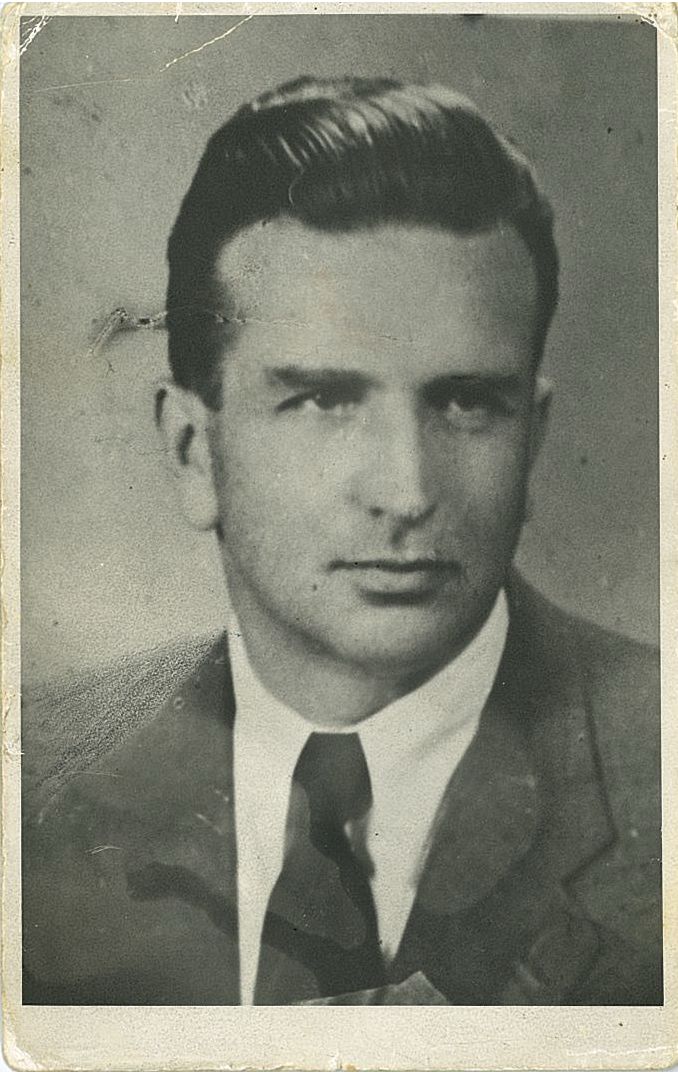
Skowron Eryk, son of Robert and Jadwiga née Krzyszkowska, born May 1, 1912, in Radzionków, Tarnowskie Góry County. Raised in a Protestant family.
He graduated from high school in Tarnowskie Góry. In 1930-1933, he studied at the University of Poznań (UAM) on the Faculty of Law and Economics, obtaining a master's degree in law. He was a member of the Silesia korporacja there.
In 1933-1934, he completed his military service at the Division Cadet Officer Course with the 73rd Infantry Regiment (corporal cadet officer), after which he returned to Radzionków, where he worked as a laborer in the "Joanna" mine.
In 1936, he arrived in Warsaw where, after a brief period working in a law firm, he collaborated as a journalist with the editorial teams of the following newspapers: ”Goniec Warszawski”, „Wieczór Warszawski”, „Dziennik Poznański”, and „Kronika Polski i Świata”. While remaining without party affiliation, he sympathized with the ONR and wrote for its Katowice-based publication “Kuźnica”.
During this period, he met Jan Stachniuk and the "Zadruga" circle. According to information from A. Wacyk provided to J. Tomasiewicz in the 1990s, Skowron was said to have shared "Zadruga's" views at the time but not openly. His then association with Zadruga is also emphasized in UB documents.
He was also a member of the Union for the Defense of Western Borderlands and the Society for Assistance to Foreign Poles.
During the occupation, he lived in Warsaw working for Herbert Tomala's folksdojch firm and E. Balicki's firm. He also maintained contacts with the Zadruga circle. He had documents allowing him to move freely and protecting him from arrest.
The nature of his contacts with the Gestapo and his political views at the time are unclear – the UB accused him of actions (de facto exploratory talks) aimed at establishing a Polish government in the General Government under German protection. He vehemently denied this (also during the investigation), explaining that his contacts with Gestapo officials (including Alfred Spielker) involved bribing them in exchange for protective documents that facilitated his business activities. It is a fact that he was in good material circumstances during this period, inter alia, he purchased a small house with a garden in the suburban Michałowice near Warsaw. He was investigated by AK counterintelligence on this occasion (according to the testimonies of former AK counterintelligence soldiers arrested by the UB), but without further consequences. It is highly probable that he discussed the aforementioned topic, (especially given his acquaintance with Ferdynand Goetel and Emil Skiwski, the latter being a declared supporter of collaboration with Germany), but this should not be equated with any actual action taken towards establishing a collaborative government.
He supported writers (including Goetel) with his own money and likely unknown conspiratorial organizations, but there are no detailed records.
In September 1944, he leaves Warsaw with the civilian population, receives documents from the aforementioned Gestapo officer Spielker to travel to Michałowice and Kraków, where he brings his family. In January 1945, he travels to Silesia, where he stays until the end of German occupation.
In his apartment, according to his daughter's information and UB documents, F. Goetel hid for several days before fleeing to the West.
Since 1945, he has worked at the publishing cooperative "Ogniwo" and has been active as a publicist (writings for: "Odra", "Ogniwa"), associated with Voivode Jerzy Ziętek and Ark Bożek. For Voivode Ziętek, he wrote speeches and articles that he signed, and he also informally advised him. He was a member of the Polish Western Union, an organization continuing the traditions of the pre-war ZOKZ. He expressed, among other things, the view that it would be appropriate to leave the German population in Poland due to its creative attitude and organizational skills. This then isolated opinion in Polish publicist at the time may be an expression of the characteristic for „Zadruga” recognition of the Protestant work ethic.
In 1947, he undertook to organize paper for the printing of a book by Jan Stachniuk („Wspakkultura”, 1948). Although he did not obtain the paper, the fact itself testifies to maintaining good relations with the Zadruga circle at that time.
In 1948, he was arrested and sentenced by the Special Commission for Combating Abuses and Economic Sabotage for trading in paper to two years of labor camp in Mielęcin (near Inowrocław), where he spent a year. Voivode Ziętek refused to help in his case, despite interventions, presumably due to opportunism in life. After his release, from 1949 Skowron lived in Warsaw, where he worked as an editor at KiW and a translator for PIW and the publishing house "Sport and Tourism". His deteriorating financial situation forced him to sell his home in Michałowice. His growing disillusionment with the situation in the country was reflected in his critical statements, indicating his lack of caution and a tendency to overestimate his personal popularity and significance. From 1951, he was under investigation by the UBP (State Security Office) of Warsaw.
In November 1953, he was informed about the presence in Podkowa Leśna of Jerzy Lewszecki, who had arrived from Great Britain to the country – an emissary of the Polish government in London, also suspected by the UB of cooperation with the US intelligence. He contacted Lewszecki, who gave him a letter from Goetel and a proposal to take up a position in the exiled government (after illegally leaving the country). Skowron agreed, he was also to promise to establish a clandestine political organization based on his contacts in Upper Silesia.
On 27 March 1954 he was arrested. On 19 March 1955 the Military District Court sentenced him to 15 years' imprisonment, reduced to 10 years after the 1956 amnesty. He served his sentence at Wronki prison and then at Strzelce Opolskie.
In February 1958, he was conditionally released from prison. Upon returning to Warsaw, he was initially employed by the Society for Scientific Organization and Management, and from 1963 as the director of the office of the Polish Economic Society (probably helped here by previous acquaintances, including Professor E. Lipiński). He also became involved in promoting "Good Work Clubs," expressing hope that this was one of the ways to "humanize communism" and break away from the USSR. He was determined to act in this direction using legal methods. These declared intentions among acquaintances and activities within the PTE (Polish Economic Association) and the Warsaw Club of Good Work, of which he was president (including meetings with Stefan Kisielewski), led to the establishment of the SOR „Ekonomista” by the SB (Security Service) in 1963. As a result of the SB's actions and the intervention of the Science Department of the CCP (Central Committee of the Polish United Workers' Party) in 1964, he was deprived of his job at the PTE. He was also denied a passport to Norway, where he had received an invitation. He then worked at the Union of Building Carpentry Enterprises, still living in Warsaw.
He went through a short period of fascination with General Mieczysław Moczar (real name Mikołaj Diomko), which was also related to his critical assessment of the Jewish lobby in the life of the Polish People's Republic. In 1965, he attempted to meet Moczar, and at that time, SB officers proposed cooperation to him in the capacity of an informant, which he refused.
In 1966, the SB (Secret Police) converted SOR "Ekonomista" into an operational observation case, which was subsequently closed. However, Skowron had his foreign travel restricted (i.e., prohibited from traveling abroad).
In the 1970s, the employer issued several of Skowron's brochures on work organization to him.
Contacts with Marek Skuza, whom he knew from prison, and Kazimierz Janusz, then activists of the Civic Committee for the Defense of Human Rights, once again drew the attention of the Security Service to him.
17 III 1978 was recruited as TW SB „66” by KS MO officer Lech Wicherkiewicz, on a voluntary basis. He provided information about Skuza and Prof. E. Lipiński, and in April 1980 he passed on a letter received from former Zadruga member Walenty Nowacki from the USA.
He did not receive any remuneration during the entire period of cooperation. His case officer emphasized that Skowron supported Gierek's policies. Stanisław Potrzebowski, who visited him at that time while collecting materials for his doctorate, reported that Skowron had very technocratic views, which would correspond to his support for Gierek. This - in combination with his critical assessment of the Jewish lobby, which he expressed both in conversations with family members, representatives of the opposition (including Leszek Moczulski), and his case officer - would explain this surprising decision.
Deregistered in 1980 due to poor health and the resulting loss of operational capabilities.
Died on October 15, 1982, in Warsaw.
Married to Halina née Michałowska, d. Anna (b. 1944).
Sources:
Archives
IPN BU 01224/1032/CD1 Skowron Eryk s. Roberta ur.01.05.1912 – materials of SOR „Ekonomista”
IPN BU 001121/2716/CD1
IPN BU 00277/502/1 TW "66" Personal File
IPN BU 00277/502/2 File of a Secret Collaborator
Literature
Heska-Kwaśniewicz Krystyna Taki to mroczny czas. Losy pisarzy śląskich w okresie wojny i okupacji hitlerowskiej, Katowice 2004
Tomasiewicz Jarosław Political groups and social organizations in the Silesian-Dąbrowa Voivodeship, in: The Year 1945 in the Silesian-Dąbrowa Voivodeship, ed. A. Topol, Katowice 2004
Wacyk Antoni Jan Stachniuk...
Walczak Jan General Jerzy Ziętek, Katowice 1996
Żerosławski Czesław Catholic Thought on the Homeland. Ideological and Political Concepts of the Clerical Underground 1939-1945, Warsaw 1987
Other
Information from Anna Kijek (daughter). Information from Jarosław Tomasiewicz and Stanisław Potrzebowski.
Bibliography of works by Eryk Skowron
40
Leverages of productivity in an enterprise W-wa 1973, published by the United Industry of Building Carpentry
Models of research, development, and implementation organization, Warsaw 1974, published by the Union of Building Carpentry Industry
On the Principles of Cooperation, Warsaw 1973, published by the United Association of Building Carpentry Industry
Style of management and management effects: principles of optimal management, Warsaw 1973, published by the United Association of Building Carpentry Industry
System of Training of the Building Construction Joinery Industry Federation, Warsaw 1972, published by the Building Construction Joinery Industry Federation
Requirements for Optimal Management of Enterprises, Warsaw 1972, published by the United Association of Building Carpentry Industry
Integrated information system and systemic management as drivers of progress, Warsaw 1972, published by the United Association of Building Carpentry Industry
Translations (from German):
Feuerbach L. On the Essence of Religion, Warsaw 1953, published by PIW
Priester E. I was in Korea, Warsaw 1951, published by "Książka i Wiedza"