
Marchaj Czesław "Władybor"
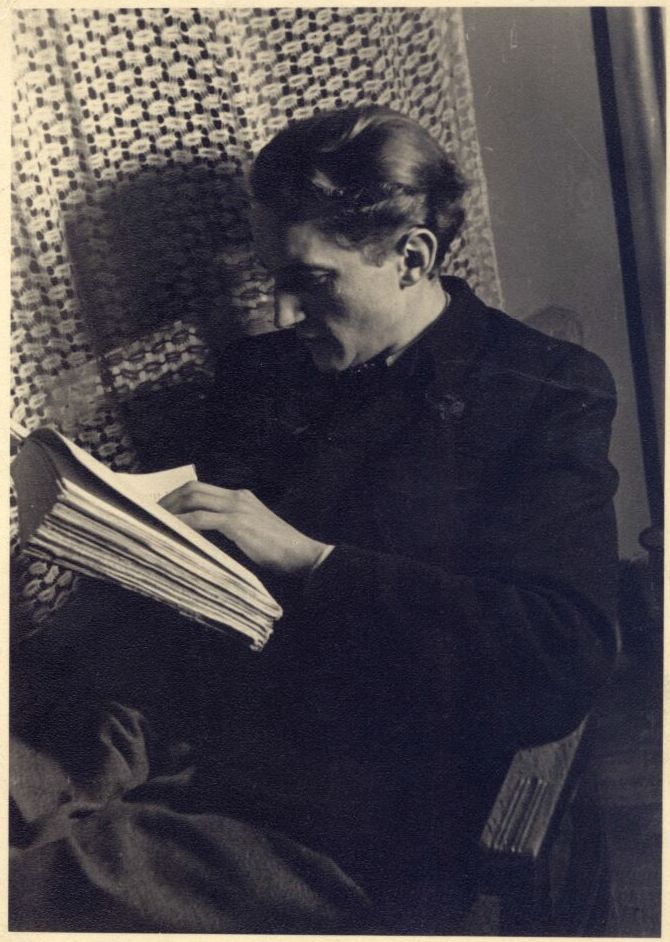
Marchaj, Czesław, son of Michał and Stanisława née Mulewicz, born July 9, 1918, in Słomniki. Father was a police officer.
He attended high school in Kielce.
In 1933, he moved with his family to Warsaw, where his father served in the Main Command of the PP. In 1939, he graduated from the State Technical-Aviation School with first place, which gave him a scholarship for a several-week stay in Paris. After returning, he was employed at the Aerodynamic Institute at the Warsaw University of Technology.
In September 1939, he was evacuated with the staff of the Institute to Kowel and then returned to Warsaw. He engaged in occasional trading. In 1942 (or 1940?), he established contact with the Zadruga circle and moved to Saska Kępa, where his pre-war acquaintance Józef Gałązka, who was also known to the Zadruga members, lived.
He gets to know Jan Stachniuk and becomes a supporter of his views. Together with Damazy Tilgner, he produced spirit from moonshine, whose illegal sale was one of his sources of income and also a source of support for the Zadruga circle. He supported, among other things, the treatment of Józef Kowalczyk "Sławbor". He adopted the name "Władybor".
He became a member of the Stronnictwo Zrywu Narodowego and participated in distributing the publication "Zryw".
He completed the ZWZ-AK officer training school (platoon commander's assistant, codename "Bor") and was assigned to intelligence, subsequently carrying out intelligence tasks for the AK (mainly observation of the Gocław airport area in Warsaw). He also attended secret Philosophy Faculty of the University of Warsaw classes. In his fiancée Janina Bartlakowska's Warsaw apartment, training meetings for Zadruga youth took place.
In 1943, arrested by the Germans, he escapes from transport. Initially, he hides in Warsaw, then he goes to Kazimierz, where he stays until the end of German occupation, breaking all organizational contacts.
After expelling the Germans, he moves to Lublin, where he gets married and works as a journalist for the weekly „Wieś”. In 1945, after a brief stay in the ruined Warsaw, he arrives in Sopot, where he takes up work as the transport manager at the cooperative „Wspólnota Morska”. At the same time, he renovates an abandoned German yacht and organizes the Yacht Club. He maintains contacts with the Zadruga circle, but they are mainly social, and he dedicates himself primarily to sailing.
In 1949, arrested on charges of attempting to flee the country. Transferred to Warsaw, he was imprisoned, inter alia, at Koszykowa Street in a cell with Jan Stachniuk, and later at Rakowiecka Street in a cell where those sentenced to death were held. The UB probably attempted to link his case to the trial of Jan Stachniuk, and he – to connect it to the planned trial of Widy and Gomułka, but these plans were abandoned. Marchaj was transported to Gdańsk where in 1950 he was sentenced to 18 months in prison for attempting to escape (he did not admit it, but other alleged participants did).
After serving his entire sentence, due to the prohibition of living on the Coast, he returned with his family to Warsaw where he ran a private workshop producing items from plastic, while also being active in the Polish Sailing Association, where after the 1956 changes, he reached the position of vice-president. As a sailor, he achieved great sporting successes, including winning the international regatta in the Finn class in Sopot in 1956.
In 1957, he published "Theory of Sailing," a manual that was repeatedly reprinted and translated into foreign languages (including English and Russian).
In April 1960, recruited for cooperation with the Ministry of Internal Affairs intelligence, adopts the codename "Jan II".
The primary motive was the desire to obtain a passport necessary for continuing his sailing sports career and enabling him to start his scientific career. Interest in his book led to a proposal for a scientific internship in Southampton (Great Britain), which would have been impossible without a passport. The information provided about people from his environment was generally positive for them and apparently covered matters commonly known in that circle. He also provided intelligence information from the UK. During the period of cooperation, he was not paid, but the MSW supported his efforts to obtain a passport. From 1962 to 1969, he was the representative of the Polish Sailing Association in YIRU (now: ISAF - International Sailing Federation). In 1969, he was recalled from this position for his critical remarks regarding the policies of the PRL authorities (known to the authorities, inter alia, from agentural sources and perlustration of his correspondence).
In 1967, he returned to Southampton, where he worked at the local university. He published a series of works on the theory of sailboat construction and use, served as a consultant for the construction of racing sailing yachts (Lionheart, America's Cup 1980), and participated in investigations into maritime disasters involving sailing ships.
In February 1971, due to his refusal to return to the country and hostility towards the PRL (which the Ministry of Internal Affairs established, inter alia, from agentural sources and perlustration of correspondence), he was removed from the agent network.
In 1970, he received political asylum in the UK. He informed the British security services and the authorities of the Government of the Republic of Poland in Exile about his cooperation with the PRL intelligence. This probably contributed to him obtaining political asylum. He also received British citizenship but never renounced Polish citizenship.
In 1990, he retired and moved to France (Gascogne) where he owned a farm. He continued to give lectures on sailing-related topics, being invited by institutions dealing with this subject as an international authority in sailing.
In 2012, he returned to Poland on a permanent basis and settled in Warsaw.
Decorated with the AK Cross and the Military Medal.
Wife Janina, maiden name Bartlakowska, son Marcin, born 1946.
He died on July 21, 2015, in Warsaw.
Sources
Archives
Archive IPN
IPN BU 001121/597/J Personal file of TW codenamed „Jan II”
IPN BU 00249/31/1
IPN BU 00249/31/2
IPN BU 00249/31/3
Interview with Czesław Marchaj (born July 9, 1918 in Słomniki), former member of the Stronnictwo Zrywu Narodowego, soldier (corporal cadet) of the Home Army, and adherent of Zadruga („Władybor”).www.niklot.org.pl
Literature
Lissowski T. (ed.) Janka Kłopocka, Warsaw - Koźmin 2014;
Wacyk A. Jan Stachniuk 1905-1963. Life and Work, v. 1976, v. 1978, v. III, 1984, ts. sup. xerocopy in the author's collection,
Profit J. Life's Sailor's Tale: A River Interview with Czesław Marchaj, Warsaw 2013
Other
Information by C. Marchaj.
Tomasz Szczepański