
Jędrzejewski Tadeusz "Wszebor"
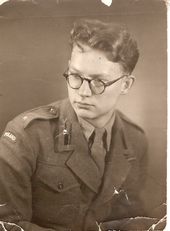 Tadeusz Jędrzejewski („Wszebor”), son of Stanisław and Bronisława née Szeliga, born 2 October 1921 in Warsaw, in a family of a railway worker.
He attended the Adam Mickiewicz Gymnasium, obtaining his "small matura" there.
In the period of 1936-1939, a member of the Polish Scouting and Guiding Association (ZHP), in 1939 became the platoon leader of the 99rd Warsaw Scout Troop.
In the September campaign, a volunteer in the Polish Army, he served in III/32 pp, fought in the Działdowo area where he received a gunshot wound in his arm. The result of the wound will be permanent impairment of the left hand's mobility.
After returning to Warsaw, he joined the underground ZHP. In 1940, he established contact with Zadruga and was part of the group referred to as the "kosynierzy" by Stachniuk. Due to Stachniuk's preference for creating a center of thought, which young people eager to fight were less suited for by nature, this group was transferred to the Kadra Polski Niepodległej, which was under the ideological influence of the activists of the "Zryw" group (later the Stronnictwo Zrywu Narodowego) and, through them, also of Zadruga. In April 1940, J. left the ZHP and joined the KPN, which was merged with the AK in 1943. He conducted the purchase of short weapons, small sabotage actions (including gassing cinemas), and mass distribution of underground press.
At the same time, he cooperates with the "Zryw" environment, joining the editorial board of this publication, as well as the KPN's "Kadra" publication. He also leads the youth group of this environment.
In July 1943, he completed the underground School of Cadets as a platoon leader's cadet.
In the period from June 1941 to October 1943, he worked as a warehouseman at a vegetable wholesale in Żelazna Brama Square in Warsaw, where he stole "Liferscheiny" - orders with original German stamps, and also participated in poisoning apples intended for the German army. In the autumn of 1943, he received an assignment to the partisans, from November 1943 to February 1944 he served in the detachment of Lieutenant "Tomek"/"Ostoja" (Józef Gajewski) in the Łuków-Siedlce area. After returning to Warsaw, he was assigned to the disposable units of Kedyw (company "Szczęsny", battalion "Miotła").
During the Warsaw Uprising, he fought in the "Miotła" battalion as part of the "Radosław" Group, following its combat trail from Wola through the Old Town, Śródmieście, and Czerniaków. He participated in the battles for the Monopoly on Wola, on Kacza Street, at Stawki, and in the defense of St. John of God Hospital (Bonifraterska Street). He took part in the unsuccessful canal descent to Plac Bankowy. He crossed the canals from pl. Krasińskich to Śródmieście (on Warecka Street). He commanded the defense of the outpost at Książęca Street (currently the Museum of the Earth). Wounded twice, decorated twice with the MC. Promoted to second lieutenant by order of 9 IX 1944.
After the defeat of the Uprising, he was in German captivity, staying in the Sandbostel camp. After liberation, he was temporarily in PWX at Camp Verden, then in Delmenhorst. He established contacts there with A. Wacyk's group in Great Britain.
14 XI 1945 he returned to the country. From December 1945 to June 1946, he worked at the Bydgoszcz „Ilustrowany Kurier Codzienny” (published under the auspices of Z. Felczak). In the summer of 1946, he moved to Poznań, where from August 1946 to August 1947, he worked in the editorial office of the „Zryw” magazine, which was the legal continuation of the underground periodical published by the SZN. The team of the magazine defined itself as neonationalist movementHe is the deputy editor-in-chief there, and the magazine publishes texts by members of Zadruga and the "Stronnictwo Zrywu Narodowego." (Jan Stachniuk also wrote there under pseudonyms.) In his publicistic work on the pages of "Zryw," J. was close to positivist stances, emphasizing the need to strengthen cultural and civilizational potential In the existing realities of Poland, he also criticized (in a veiled manner) Marxism from Zadruga positions, and justified remaining in a relationship with the USSR (in private conversations he used the term dependence) with reasons of state and geopolitical considerations.
After the liquidation of "Zryw" (the last known issue was No. 6/1947 from April 1-15, 1947), he worked at the Provincial Press Control Office (censorship) in Poznań starting in August 1947.
In 1947, he passed his high school examinations in Poznań, where he then began studying at the Faculty of Humanities at UAM, which he continued at the Faculty of Philosophy at UW (sociology section) where he obtained absolutory, but did not defend his diploma.
In December 1947, he joined the PPR (Polish United Workers' Party), remaining a member of the PZPR (Polish United Workers' Party) until 1981.
In May 1948, transferred to Warsaw for service, where he worked in the Central Office for Press and Publishing. From 1950 until August 1960, he worked at the Publicist and Information Agency as a publicist specializing in domestic issues.
He testified as a witness in the trial of Jan Stachniuk in 1952. He was investigated by the UB in connection with the "Zadruga" case, but his case file, which was most likely established, did not survive. According to (a document containing numerous errors) an UB document, it was J. who was supposed to provide financial assistance to Stachniuk from F. Widy-Wirski, however, Wacyk, who reported on this matter in 1946, did not mention any intermediary.
From August 15, 1960, to December 31, 1981 (formally, but in fact until December 13, 1981, when he was denied entry to the building), he worked at Polish Radio in the Głos Mazowsza program as a journalist specializing in economic issues. He paid particular attention to the matters of ZM Ursus and Petrochemia Płock. He focused on industrial issues, avoiding ideological topics and statements. In September 1981, he joined NSZZ „Solidarność,” protesting on the party platform against the persecution of colleagues for their views.
During martial law, he refused to cooperate with Polish Radio and retired, dedicating himself to writing his work. Cultural determinants of personality, as well as social activities in the veteran community. He was a member of the Social Committee for the Construction of the Monument to the Heroes of the Warsaw Uprising of 1944.
Wife Halina (1926, orthopedic surgeon, Ph.D. in medical sciences), daughter Danuta (1952, Ph.D. in engineering architecture, real estate appraiser).
Decorations: Cross of Valor (2x), Military Medal (MON RP in London), AK Cross, Commemorative Badge of the "Radosław" Group, Warsaw Uprising Cross, Partisan Cross, Knight's Cross of the Order of Polonia Restituta.
Died on October 14, 1992, in Warsaw, buried at Powązki Wojskowe Cemetery.
Sources:
Archives:
IPN 00231/153 t 1. k 1-30 (Information about "Zadruga", April 21, 1950);
Certificate from 5 XII 1945 by F. Widy-Wirski regarding T.J.'s service in the Independent Polish Army, participation in the Warsaw Uprising, and decoration with the Cross of Valor - photocopy in the author's collection.
Legitymacje: Medalu Wojska (Londyn 1948), Krzyża AK (Londyn 1975); Krzyża Kawalerskiego Orderu Odrodzenia Polski (1978); Odznaki Pamiątkowej Zgrupowania „Radosław” (1979), Warszawskiego Krzyża Powstańczego (1982), letter from J. K. Kostrzewski (chairman of the Social Committee for the Construction of the Monument to the „Heroes of the Warsaw Uprising 1944") to T.J., dated 18 May 1992 — photocopies in the author's collection.
Literature:
J. Radzymińska Always independent, Wrocław 1991;
Wacyk A. Jan Stachniuk 1905-1963. Life...
The Great Illustrated Encyclopedia of the Warsaw Uprising (pr. zb.)
Relations:
Information from Danuta Jędrzejewska-Szmek (daughter), Kazimierz Majewski, Józef Sobiecki.
Press
"Zryw" 1946-1947
Other – handwritten dedication by Jan Stachniuk on a copy of „Dzieje bez dziejów” – photocopy in the author's collection.