
Felczak Zygmunt "Bożydar", "Bydgoski", "Jasiński", "Zygmunt"
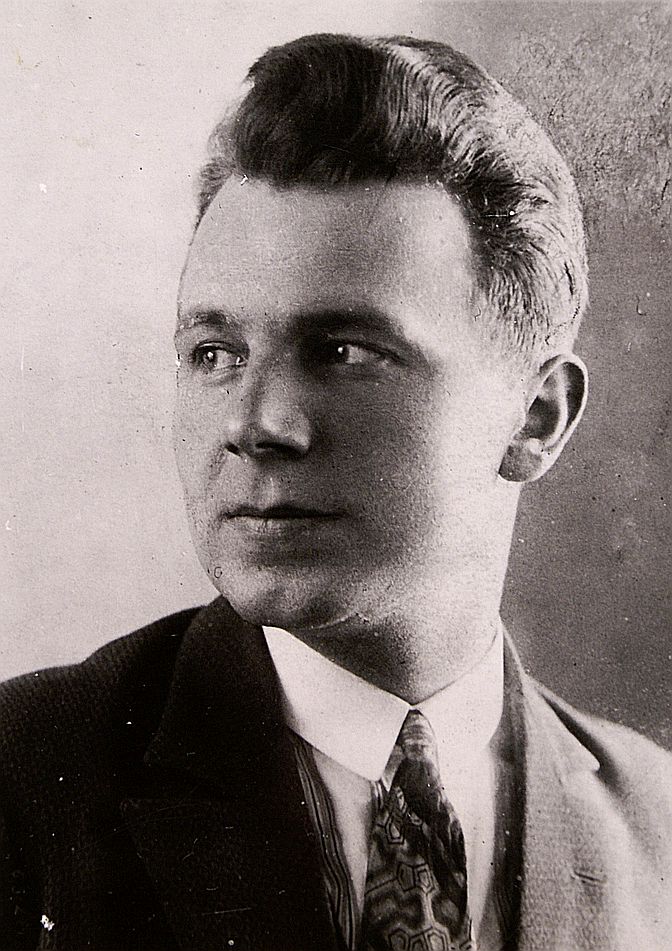 Felczak Zygmunt, son of Antoni and Michalina née Pałczyńska, born 2 V 1903 in Chorki, Łęczyca County.
Elementary school in Chorki, from 1915 a real school in Łęczyca.
Volunteer in the Polish-Soviet defense war of 1920. In 1923, he received his high school diploma - School of the Polish Scholar's Association Circle in Łęczyca.
He began studying law at the University of Warsaw but interrupted his studies in 1924. He then worked as a teacher in Łódź. In 1926–1931, he studied at the Faculty of Humanities of the University of Poznań, but again interrupted his studies.
He was active in the Workers' Youth Union "Jedność", eventually becoming its president and editor of the newspaper "Demokrata", as well as in the National Labor Party and the editor of its organ "Prawda".
From 1931, he has lived in Toruń, serving as the secretary of the District Management of the NPR and editor of "Obrona Ludu" (until 1938). From May 1934, he was a member of the National Council of the NPR, and later the Main Executive Committee. After the merger in 1937 of the NPR and PSChD into the Stronnictwo Pracy, he became a member of the Central Management. From 1937, he was the deputy editor-in-chief, and in 1938/39, the political leader of "Dziennik Bydgoski".
Twice imprisoned, once for insulting A. Hitler, and the second time for insulting J. Piłsudski and I. Mościcki.
In September 1939, in the face of the threat from the Germans, he left Bydgoszcz, moving to Chorki and then to Warsaw (1940). He organized the underground SP and introduced NPR-Left into it.
At the turn of 1941/42, he was active in the Ruch Braterski group, publishing the "Nowy Świat" newspaper and helping the homeless, Jews, and prisoners.
From 5 February 1942, representative of the SP in the Political Liaison Committee, dismissed from this position on 25 October 1942 on charges of intrigue and an attempt to undermine the party program. Excluded from the SP in February 1943.
He is one of the leaders of Zryw, a breakaway group from SP, centered around the eponymous publication (published 1942-1944), which later (March 1943) merges with Kadra Polski Niepodległej to form Stronnictwo Zrywu Narodowego, where he becomes vice-president.
During the Warsaw Uprising, the building of the Agricultural Credit Society at Kredytowa Street, which was used as an Arbeitsamt office during the war, is fought over, and later moves to Śródmieście. After the defeat of the uprising, they escape to Włochy (now a district of Warsaw). On November 30, 1944, at a meeting of activists of "Zryw," they accept the PKWN.
In February 1945, he becomes the vice-woevoda of Pomerania. In Bydgoszcz, he begins attempts to rebuild the National Party (SP). Together with F. Widyma, he leads the SP group "Zryw," which is competitive towards K. Popiel. According to Piotrowski, they are to help the communists take control of the party from within and give it a direction favorable to the new regime. Such tendencies are also visible in the letter they wrote on February 10, 1945, to the Central Committee of the United Workers' Party (PPR). Piotrowski also believes that Felczak served the communists by marginalizing and then eliminating Christian democracy from Polish political life.
After merging in 1945 with the dissident group "Zryw" and the SP, he becomes vice-president. From December 1945, he is a deputy and president of the SP Club in the National Council.
Establishes the Publishing Cooperative Zryw and publishes Ilustrowany Kurier Polski (first issue on 22 October 1945) and Arkona (November 1945). In 1946, his book "Droga wielkiej odnowy" ("The Path of Great Renewal") is published. According to Piotrowski, Stachniuk helped in writing the book, while according to Tomasiewicz, the book was written by Stachniuk but published under Felczak's name.
Felczak, as president of the Supervisory Board of the Publishing Cooperative "Zryw," together with F. Widym, helps publish Stachniuk's post-war books such as Walka o zasady and Człowieczeństwo i kultura. Felczak assists Stachniuk in obtaining a job at the Ilustrowany Kurier Polski, where he publishes under the pseudonym Dr. Mieczkowski, and also contributes to another periodical published by Felczak and Widym - "Zryw." As M. writes. Piotrowski obtained contact with Stachniuk through Widy-Wirski and had a strong influence on him, causing him to move away from "Christian-social views". Other authors also mention strong inspiration from Stachniuk's work. However, Stachniuk himself did not consider him a member of Zadruga.
Married to Anna Kaptur, née Grońska (born March 8, 1905), she had a son from a previous marriage, Bogdan, who was adopted by Felczak. He had four brothers: Franciszek, Kazimierz, Wiktor, and Wacław, the first three of whom were killed by the Germans between 1939 and 1945.
He died on July 3, 1946, of liver cirrhosis, leaving the hospital at his own request. His brother, Wacław (1916-1993, a soldier of the Home Army and historian), and later some historians, claim that he was brutally beaten en route with the inspiration of the Security Office, which was the cause of his death. The motive was said to be his desire to maintain a certain limited autonomy, even within the system. He was buried at the state's expense in Bydgoszcz. Posthumously awarded the Cross of Grunwald II class.
Bibliography:
Literature
Frazik W. Emissary of Free Poland. The Political Biography of Wacław Felczak (1916-1993), Kraków 2013
Grott B. Religion, civilization, development. Around the ideas of Jan Stachniuk, Kraków 2003.
Kunert A. K Felczak Zygmunt [in:] Biographical Dictionary of the Warsaw conspiracy 1939-1944 vol.1. Warsaw 1987.
Langrod J. S. Felczak Zygmunt [in:] Polski Słownik Biograficzny, vol. 6. Wrocław 1989.
Osiński K. Jan Stachniuk (1905-1963) - Bydgoszcz episode in the post-war history of the ideologist of Zadruga,[w:],Kronika Bydgoska, vol.22,2000.
Piotrowski M Service to an idea or servility? Zygmunt Felczak and Feliks Widy-Wirski in the latest history of Poland, Lublin 1994.
Ran-Rokicki Lech I knew Zygmunt Felczak "Tygodnik Płocki" No. 50, 11 Dec 1988
Rosołowski M Uprising [in:] Encyclopedia of White Spots vol. XVIII.
Tomasiewicz J. , Twice Unruly. Essays on the History of Polish Patriotic Leftj, Łódź 2014.
Opr. Mariusz Dymek