
Brueckman Józef „Jarosław", „Józef Mostnicki"
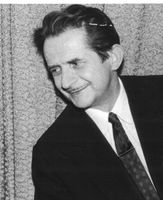 Józef Brueckman was born on June 21, 1921, in Kalisz, son of Stefan and Halina née Charszewska. The family had patriotic traditions – the father served in the First Brigade of the Polish Legions (after the "oath crisis" of 1917, he was interned in Szczypiorno) and the mother was a member of the POW.
As a one-year-old, he traveled with his parents to France, who went there for earning purposes, where he began his schooling. In 1928, the family returned to Kalisz, where after completing primary school, he graduated from the T. Kościuszko Gymnasium in 1939. He then went to Warsaw to prepare for entrance exams to the Wawelberg Technical School, where the outbreak of war caught up with him. Evacuated eastward, he returned to Kalisch, which had been annexed to the Reich, after the Soviets entered, and became involved in the independence underground. Their Kalisch apartment was requisitioned by the Germans.
Arrested in November 1939, while attempting to clear a sealed apartment of a colleague (on a looting charge, which he denied) held in the Kalisz prison on Łódzka Street. Released in March 1940 thanks to the protection of a German acquaintance – a teacher. Warned that he was on the list for deportation to forced labor, he escaped to the General Government, settling in Kielce, where he worked at the Ludwików Huta, continuing to cooperate with local conspiratorial structures (BCh) in facilitating the transfer of endangered persons from the Warthegau to the General Government. In November 1942, he was arrested, and at the same time, his mother and sister Aldona were also arrested (she died in 1943). After a difficult investigation, he was imprisoned in Auschwitz (camp number 83877), from where he was transferred to Gross Rosen (number 9326) in March 1943 and then to Sachsenhausen (number 63815), where he was assigned to the Heinkel commandos (near Oranienburg). There, in 1943, he meets Bogusław Stępiński, who convinces him of the Zadruga ideals. He joins the self-education circle led by Stępiński, adopting the name Jarosław.
In April 1945, he was evacuated along with other prisoners of the camp towards the northwest. During the march, their group was abandoned by the SS guards escorting them. The prisoners, organized into national groups and some armed with abandoned weapons, under the leadership of a Polish group, entered Schwerin on May 3, which had been occupied by the US army.
He was part of a group of Zadruga members - former prisoners, led by B. Stępiński (including Józef Flis and Czesław Rychlik), who in May 1945 laid flowers at the monument of Duke Niklot in Schwerin.
Due to illness, he was taken care of by a French field hospital for French prisoners of war and repatriated to France (Chalons sur Marn) with it. He completed a shortened course of French high school culminating in a baccalaureate diploma entitling him to enter there universities as well.
He returns in September 1946, settling in Wrocław where his mother had already moved, running an orphanage as part of the RTPD. He enrolls at the Wrocław University of Technology. Through Stępiński, with whom he maintains correspondence, he establishes contact with Antoni Wacyk, facilitating his relocation from Zabrze to Wrocław.
During the third year of his studies, he interrupts them due to tuberculosis, which (after a pneumothorax procedure) requires a stay in a sanatorium. He takes up employment in an industrial building design workshop, and later works on the expansion of the "Rokita" chemical plants in Brzeg Dolny.
While working there, he patented an invention („self-propelled, self-assembling, automatic dosing concrete plant”) that had 3 prototypes in operation. Efforts to implement the invention on a national scale failed due to resistance from the Construction Machinery Repair Combine „Zremb”, which purchased an analogous German machine. Other patents brought similar difficulties to B. (This was a common phenomenon in the PRL – purchasing abroad provided managerial staff with opportunities for trips paid in foreign currency, which was not the case with the implementation of a domestic invention.)
In 1964, he obtained his engineering diploma. He then worked at the Wrocław Building Combine "Miastoprojekt". After retiring, he worked part-time at the Central Research and Development Center for Concrete Industries "Cebet" from 1983 to 1993.
Throughout the entire period of the Polish People's Republic, he maintained contacts with other Zadruga members, undertaking cautious attempts to popularize Zadruga ideas after 1956.
Helped find a job for Bogusław Stępiński after his release from prison (1955).
He maintained contact with Zadruga members living in Wrocław (M. S. Czarnowski, Wacyk, Z. Słowiński). In the 1970s and 1980s, he wrote letters to newspapers and magazines if they published materials related to Jan Stachniuk and „Zadruga”.
Participated in an attempt to establish the Society of Lovers of Slavic Culture organized by Czarnowski (1980s), but the initiative did not succeed.
In 1982 he wrote Worldview and the Meaning of Life, which was first distributed informally as a typescript. The text, which has been published several times, is an attempt at a personal interpretation of the Zadruga tradition with strong left-liberal elements.
After 1989, he reestablished contact with individuals and groups inspired by Stachniuk's work. He was one of the founders of the Native Faith Covenant (1996).
He cooperated socially as a proofreader with the "Toporzeł" publishing house on the edition of Wacyk's "Culture of No-History" (2nd edition, 2010).
Married to Łucja (née Dalman), daughters: Jaromira, Marzena.
Died on 5 March 2012 in Wrocław.
Sources:
Works by Józef Brueckmann (chronologically):
Worldview and the Meaning of Life, in manuscript form, Wrocław 1982,
Vision…"The Polish Daily" London, May 4, 1988 [under the pseudonym Józef Mostnicki]
Vision…, in manuscript form, Wrocław 1996
Vision…, corrected version, manuscript rights Wrocław 2005
Two reviews – two dimensions of human, „Sobótka”, 1988, No. 1
Without title [letter to the editor] "Zdanie" No. 6/1988 p. 58
Reflections after 60 years, ts., Wrocław, duplicated, 2002 (camp memoirs).
About Jan Stachniuk - Stoigniew. The creator of the ideological Zadruga movement - culturalism. Not for the last time! Wrocław 2004 duplicated ts.
Biography, in: „Politeja" 2(6) 2006 pp. 597–604
Rychlik Czesław Human Examination, duplicated ts. (in the Author's collections)
Information by Stanisław Potrzebowski.