
Majewski Kazimierz Stanisław
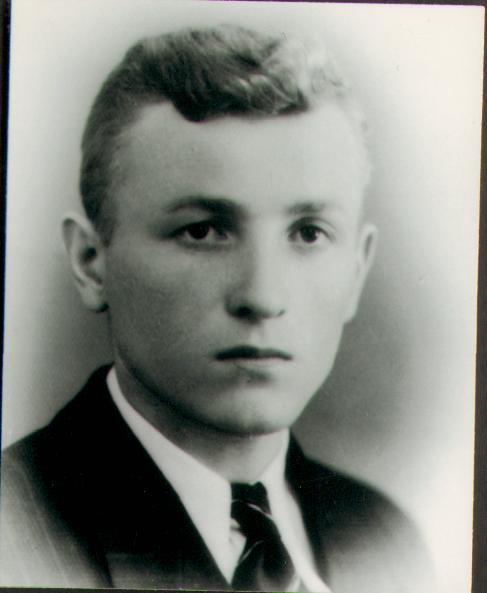
Majewski Kazimierz Stanisław (also known as Olszewski or Sobolewski) „Wszebor” („Bosman”, „Góral”)
Born July 26, 1922 in Warsaw, son of Stanisław and Zofia née Ogonek.
He lost his father at an early age and was raised by his mother. He attended the Mechanical Gymnasium (until 1939, First Male Vocational School named after Konarski) in Warsaw (Wola). In June 1942, after completing four classes in the locksmithing and mechanical engineering program, he passed the apprenticeship exam and began working as a locksmith at the K. Wasilewski and s-ka Steel Pen Factory on Płocka Street.
Late autumn 1939 or early 1940, he established contact with the Zadruga circle. He participated in discussion meetings organized by this group, and due to his lively nature and desire to act, the younger members were referred to by Stachniuk as the "Kosynierzy" (Cossacks). He was part of a group whose meetings were organized, among others, by Józef Kowalczyk "Sławbor". He adopted the name "Wszebor". In 1940, he introduced his high school friend, Teodor Jakubowski ("Todek", "Wodzibor"), to the Zadruga circle. He confirmed the fact that initially this group used the "Roman greeting," which was abandoned due to negative associations under German occupation.
Until 1941, he served in the Military Confederation, then joined the Home Army (ZWZ), where he used the pseudonyms: „Bosman” "Góral" and the conspiratorial name "Kazimierz Olszewski".
In the spring of 1943, he participated in the liquidation of Henryk Rybka, who had confessed to the intention of killing the leaders of Zadruga, for which he was suffocated by Teodor Jakubowski. Majewski, along with Ryszard Remiszewski („Jarobój”) and Zbigniew Chwalbogowski, provided security for this operation.
During the Warsaw Uprising, he fought in the "Waligóra" Group, platoon 343, then in the group of Captain "Hal" (W. Stykowski). On August 3, he was wounded in the head in a fight on Górczewska Street, and was treated the next day before returning to his unit. He was injured again on August 19 (shot in the leg and arm) on Waliców Street while eliminating a German sniper (so-called "rooftop shooter"). He was then treated in field hospitals.
After the capitulation of the uprising, he was sent to a transit camp in Ożarów, then to Stalag 344 Lamsdorf (Łambinowice), and on November 17, 1944, transferred to Stalag VIII C Sagan (Żagań). In February 1945, the prisoners were forced to march on foot to a copper mine near Gotha, where on April 2 he was liberated along with others by units of the US Army.
He then stayed in the transit camp in Nordheim, from where he returned to the country in July 1945.
In September 1945, at the proposal of his fellow conspirator Władysław Hański, he carried out robbery attacks with him – in September 1945 on a jeweler in Warsaw (after exchanging fire with a militiaman, he was wounded in the hand) and in October 1945 in Piotrków Trybunalski. He was arrested and detained in a Warsaw detention center, from which he escaped in the second half of December 1945 (along with Hański and two other prisoners).
He hides in Szczecin where he obtains a repatriation card in 1947 with which he acquires other documents under the name of Sobolewski Kazimierz. He settles in Wrocław where he enters into a marital union and works as a painter.
Arrested on May 27, 1953. During the investigation, his connections with "Zadruga" or details of his service in the AK did not come to light – he stated during interrogation that he served in the PAL during the Warsaw Uprising. On January 7, 1954, he was sentenced by the Military Court in Warsaw to a combined sentence of 5 years in prison for robbery, possession of weapons, forgery of documents, and escape from custody. His lawyer was Attorney Mec. Nowogródzki filed a revision complaint, which was granted by the Supreme Court, sentencing Majewski on February 26, 1954, to a combined sentence of 2 years' imprisonment and 1 year's deprivation of public and honorary rights.
Released from prison in December 1954, as part of conditional early release (the fact that the prisoner was meeting 135% of the norm was also taken into account).
After serving his sentence, he returned to Warsaw where he worked in his profession. In 2005, he published fragments of his memoirs.
In 2009-2010, he provided information to T. Szczepański.
He remained a Zadruga adherent in his convictions, although he expressed them in a non-philosophical language. He combined Polish patriotism with a critical assessment of the Catholic Church's role in the nation's life and at the same time with anti-communism and a critical assessment of the role of the Jewish lobby.
He died in Warsaw on February 20, 2012, and was buried at the Powązki Wojskowe Military Cemetery.
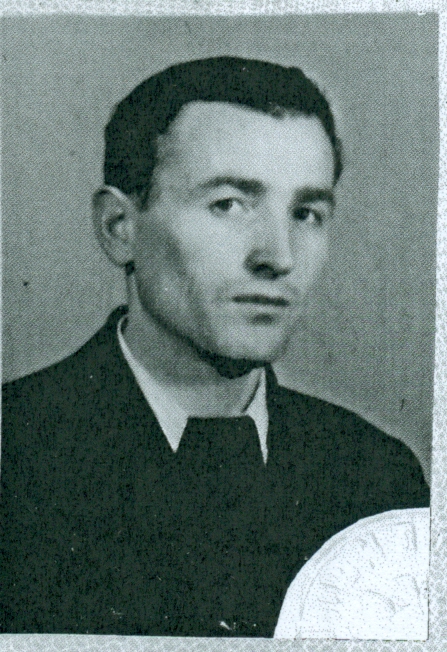
Kazimierz Majewski around 1950 from IPN data
Sources:
Archives
IPN BU 1015/378 Majewski vel Sobolewski
Teodor Jakubowski Cassation and Revision Complaint in: „Dokumenty z procesu Jana Stachniuka i towarzyszy", in: „Trygław" no. 5 (2001) (Original: APW m.st. W-wy, file ref. K 118/52)
Internet-based
http://www.1944.pl/historia/powstancze-biogramy/Kazimierz_Majewski_7 (The website of the Warsaw Uprising Museum)
Other:
Majewski K. Two Days in the Life of an Insurgent, „Budapress” January 2005 (excerpts from memoirs)
Oral information from Kazimierz Majewski.
T. Szczepański