
Brykalski Zygmunt "Duży", "Dąbrowski"
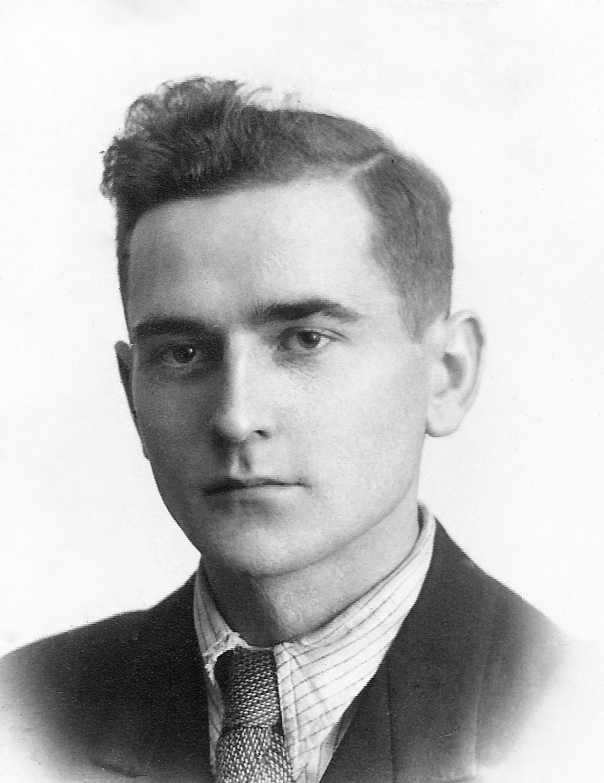
from the collection of the Z. B. family
Brykalski Zygmunt "Duży", "Dąbrowski"
Zygmunt Brykalski was born on April 24, 1922, in Warsaw, son of Ignacy and Maria née Moczarska. His father was a butcher and later a small businessman. After his father's premature death, he was raised by his mother (along with nine siblings).
He completed the first grade at the I Male Gymnasium in Warsaw, and then studied at the gymnasium in the Cadet Corps in Rawicz, which he graduated from in 1939.
In September 1939, he volunteered for the forming volunteer company of the Polish Army at the Citadel, where he served as a private soldier until the capitulation of Warsaw.
He then worked as a messenger for the Metropolitan Social Self-Help Committee, and later as a window cleaner and selling pastries, he also delivered flour to a confectionery shop. At the same time, in 1940-1942, he completed the legal Metallurgy and Foundry School of the Second Degree while also completing the humanities high school course on secret classes. In 1942, he received his diploma as a technician - metallurgist and obtained a clandestine high school diploma. Then he attended secret lectures at the Free University and the Faculty of Humanities at the University of Warsaw, but without taking exams.
In 1941 (or spring 1942), through his pre-war acquaintance Józef Kowalczyk ("Sławbor"), he establishes contact with the Zadruga circle. He joins the "Zryw" group and the "Kadra Polski Niepodległej," organizing its youth environment, including organizing self-education meetings at Kowalczyk's place and other locations. He came into contact with Tadeusz Jędrzejewski („Wszebor”), Feliks Widy-Wirski, and Zygmunt Felczak at that time, under whose command he remained for a while, serving, inter alia, as his liaison.
In 1944, he fought in the Warsaw Uprising in Ochota. He was promoted to the rank of second lieutenant and decorated with the Cross of Valor (formally granted in 1945). Wounded in the leg, he was transported as a civilian to the camp in Pruszków, and then he got to the hospital in Milanówek. Due to the threat to the wounded posed by the Germans, he hid in a private apartment in Milanówek until January 1945.
From February 1945, he worked as Zygmunt Felczak's secretary in Bydgoszcz, and from summer 1945 as an "officer for special assignments" (according to his own term - de facto personal protection) for voivode Feliks Widy-Wirski in Poznań until mid-1946. He then worked at the biweekly "Zryw" (Poznań 1946-1947). From July 1947, he worked at the Central Office for Press, Publishing and Cinematography as a censor.
He was a member of the Stronnictwo Pracy party in 1945-47, and joined the PPR at the end of 1947.
He studied at the Faculty of Law and Economics of Adam Mickiewicz University in Poznań, receiving his absolutory in 1949.
In July 1949, he moved to Warsaw where, probably with the support of Józef Kowalczyk, he obtained a job at the Main Office for the Control of Press as a censor.
In XI 1950, he was dismissed from his job at the Central Office for Jewish Affairs for concealing from the Party his membership in the Zadruga organization during the occupation. (He also received a party reprimand.) Thanks to protection from the Provincial Committee of the Polish United Workers' Party, he obtained a job at the Workers' Agency.
He then worked at „Życie Warszawy” and in the monthly „Przyjaźń”, the organ of the Polish-Soviet Friendship Society.
During interrogation by the UB in the case of Widy-Wirski (in February 1953), he distanced himself from Zadruga most likely due to practical opportunism. His membership in the PZPR also did not reflect his true beliefs but was a situational choice. However, among his closest friends, he expressed the view that socialism in Poland had to fall (in his later years, he prepared notes justifying this thesis), and he instilled in his son the belief in the importance of Slavic tradition for Polish culture.
Married to Anna of the Światopełk-Czetwertyński family, son Jarosław (1951).
Decorations: Cross of Valor (1945), Silver Cross of Merit (1946), Grunwald Badge (1946), Medal of Victory and Freedom (1946), Medal of the 10th Anniversary of the People's Republic of Poland (1955), Gold Cross of Merit (1957), Knight's Cross of the Order of Polonia Restituta (1964), Officer's Cross of the Order of Polonia Restituta (1979), Warsaw Uprising Cross (posthumously 1982).
He died of cancer on August 26, 1980, in Warsaw.
Sources:
Archive IPN
IPN 00231/153 t 1. (Information about "Zadruga", from April 21, 1950);
IPN BU 01178/1465/D Brykalski Zygmunt
IPN BU 01251/284 part 2 (there the interrogation protocol of Z.B. regarding Widy-Wirski)
Literature
Radzymińska J. Always Independent, Wrocław 1991
Other
Information of Jarosław Brykalski.